At a narrow lunch table in Bangkok, the bottle arrives before the rice has stopped steaming. It is clear glass, refilled many times, its plastic cap slightly stained from years of fingers and heat. Beside it sits a small bowl of sliced chillies floating in amber liquid, the cut edges pale and sharp. Someone nudges it towards the centre, not as an announcement but as a gesture of readiness. The spoon taps porcelain. The fan turns above us. From the kitchen comes the smell of garlic, hot oil, and fish sauce meeting flame for one brief, salty second.
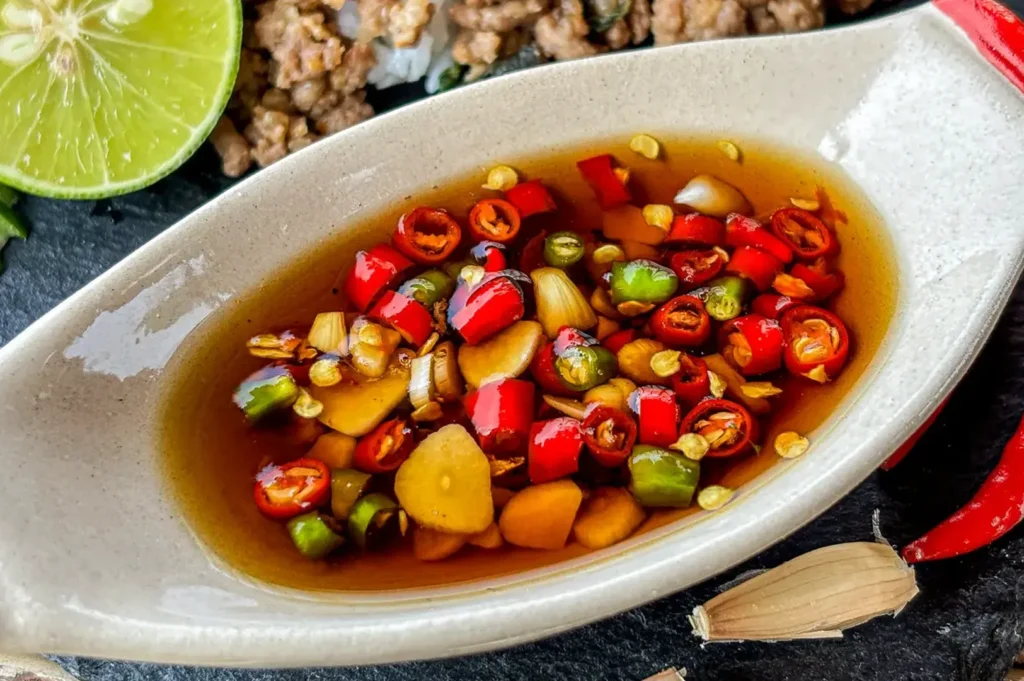
This is nam pla — น้ำปลา — pronounced roughly “nahm plah”, Thai fish sauce. In plain terms, it is a liquid seasoning made from fish and salt, left to transform slowly until it becomes clear, savoury, and deeply aromatic. At the table, it does not behave like a sauce poured for abundance. It works more quietly than that. A few drops can pull sweetness forward, sharpen a bowl of rice, or give soup a firmer edge. In many Thai meals, it appears as part of prik nam pla, fish sauce with sliced chillies, sometimes lime and garlic. The craft begins long before the table: in the patience of salting, pressing, waiting, and drawing off a liquid that carries depth without heaviness.
What interests Eat Drink Asia is not only its flavour, but the way people use it. At a shared table, seasoning is both personal and social. You adjust your own spoonful, not the whole dish. You taste first, then decide. Too much fish sauce can flatten a meal into salt; too little can leave it polite but unfinished. This small act teaches restraint without making restraint feel severe. It also holds memory. Someone may add more chillies because that is how their father ate noodles. Someone else may avoid touching the bottle because the cook has already balanced the dish. These choices happen quickly, almost invisibly, yet they reveal how people carry appetite, habit, and respect into the same bowl.
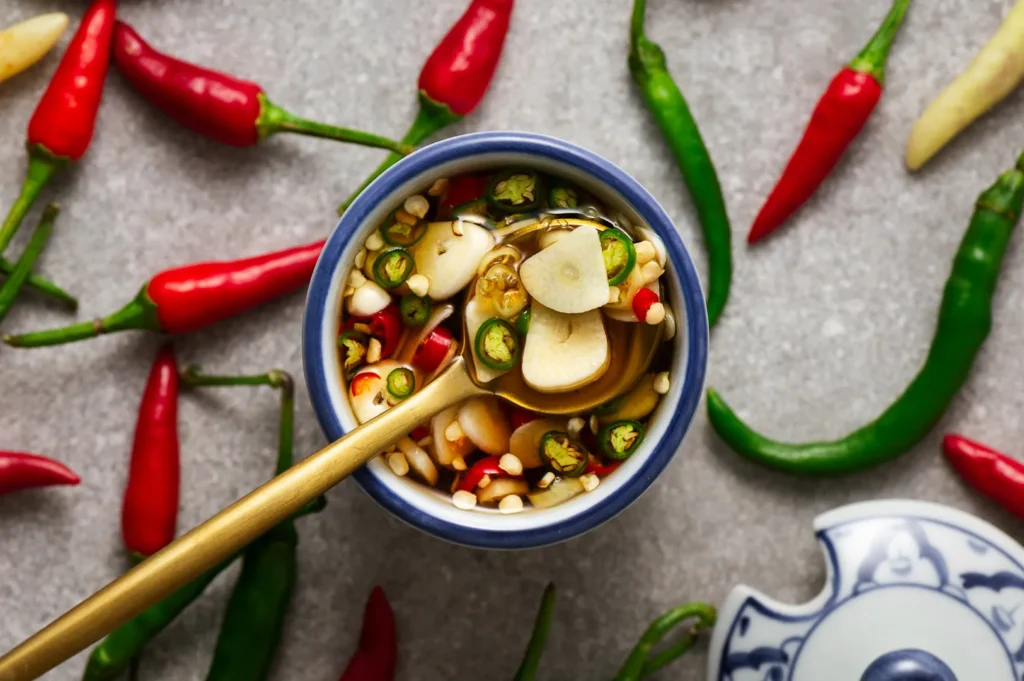
There is a tension now between convenience and care. Fish sauce comes in sachets with takeaway meals, in neat supermarket bottles, in polished restaurant cruets designed to look clean rather than lived in. None of this is wrong; food has to move with the speed of the city. But something changes when the table loses the small, shared grammar of seasoning. The old bottle with its cloudy rim asks for attention. It asks you to notice before you alter. It reminds you that flavour is not only built in the kitchen, but completed in relation to others.
By the end of lunch, the bowl of chillies has darkened slightly, its seeds resting at the bottom like sand. The bottle returns to the side of the table. Nothing dramatic has happened. Still, the meal feels more exact because of that quiet liquid, waiting to be used carefully.

Korean Street Food Is Built for Movement, Heat, and One-Handed Eating
Eda Wong | October 3, 2026
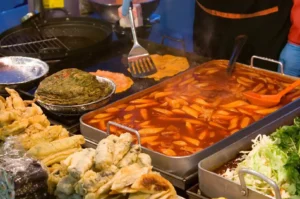
The first time I ate tteokbokki in Seoul, I burned my tongue standing up. It was late, the air was sharp with cold, and I had stopped at a small street food stall near a subway exit because the steam pulled me in. The woman handed me a paper cup of rice cakes in red…
-
Mrs Pho and the Bowl That Makes Somerset Feel Like a Vietnamese Family Table
Eat Drink Asia Team | October 1, 2026
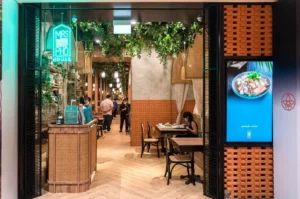
I wasn’t hungry when I walked into 313@somerset. I’d come for something else entirely; an errand, a shop I needed, the usual Orchard rush of people moving faster than the escalators. But somewhere on the first floor, past the noise, I caught the smell of star anise and beef bone, and my feet slowed down…
-
The Carving Knife at Colony, and the Way We Mark What Matters
Eda Wong | September 30, 2026
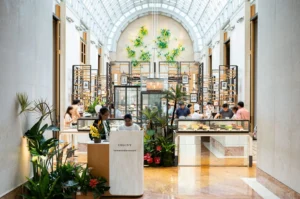
By Eda Wong for Eat Drink Asia. It’s late morning, and the light is doing most of the work. It pours through the high windows of Colony, at The Ritz-Carlton, Millenia Singapore, spilling across white tablecloths and the vintage prints on the walls. Marina Bay hums somewhere outside, but in here the room feels a…
-
Co Chung Vietnamese Restaurant and the Gỏi Cuốn That Makes Fresh Herbs Do the Work
Dio Asahi | September 29, 2026
I found it by accident, the way you find most things in a mall basement. I’d come down to Plaza Singapura’s B2 for something else entirely, drifting past the usual food-court noise, when I caught the smell of star anise and beef bone coming from a corner. I followed it. And there it was —…
-
Vietnamese Spring Roll: The Recipe That Only Works When the Herbs Stay Awake
Eda Wong | September 26, 2026
Fresh Vietnamese spring rolls, or gỏi cuốn, look delicate, but the recipe is really about control: barely softened rice paper, dry herbs, restrained noodles, clean protein, and a dipping sauce sharp enough to wake the whole thing up. This is not the fried version, chả giò or nem rán. This is the cool, translucent, herb-heavy…
-
Best Steakhouse Singapore: From Fire-Kissed Icons to Old-School Beef Plates
Eat Drink Asia Team | September 24, 2026
I didn’t set out to write about steak. It started with a bad day and a craving for something that pushed back when I bit into it. One dinner turned into a habit, and over a couple of years I found myself at counters, coffeeshops, and dining rooms all over this island, chasing the same…
-
The Ice Counter at Carousel, and the Table Everyone Can Reach
Dio Asahi | September 23, 2026
By Dio Asahi for Eat Drink Asia. It’s a Saturday evening, and someone across the room is carrying a birthday cake. The candles are lit, the walk is careful, and a whole table turns to watch. Plates clink. A child laughs somewhere. The room at Carousel, inside Royal Plaza on Scotts, isn’t quiet — it…
-
Tiong Shian Porridge Centre Review: The Soft Counterweight to Chinatown’s Crisp Toast
Dio Asahi | September 22, 2026
I’d spent the morning with kaya toast. Crisp bread, cold butter, the clean snap of it between my teeth. Good, all of it. But by the time I’d walked a few streets over to New Bridge Road, my mouth wanted the opposite. Something warm. Something that gave way instead of shattering. That’s how I ended…
-
Tong Ah Eating House Review: A Chinatown Breakfast That Still Begins with Kaya Toast
Eda Wong | September 19, 2026
I almost walked past it. I’d been looking for the old triangular building, the red-and-white one you see in every photo of Keong Saik, the one that made Tong Ah feel like a landmark before you’d even ordered anything. But that’s not where it lives anymore. It’s a few doors down now, at 35 Keong…
-
Breakfast at Chinatown Singapore: How Migration Built the City’s Morning Table
Eat Drink Asia Team | September 17, 2026
The first time I ate breakfast in Chinatown, I got it wrong. I arrived at eleven, hungry and hopeful, and found the kopi stalls already turning toward lunch. The porridge uncle was packing up. The toast man had switched to slicing char siew. I ate a rushed plate of noodles standing near a pillar, sweating,…