By Eda Wong for Eat Drink Asia.
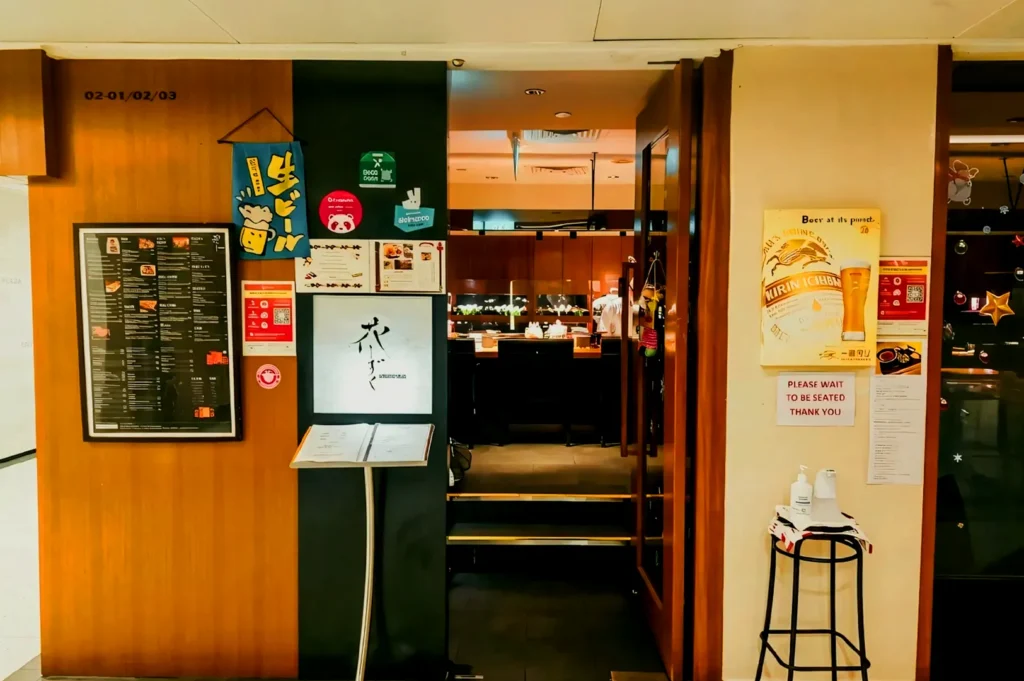
The lift doors open on a floor of Cuppage Plaza that has seen better decades. Peeling signage. A corridor that smells faintly of old carpet and cigarette smoke drifting from somewhere. Then a door slides shut behind me, and the noise falls away.
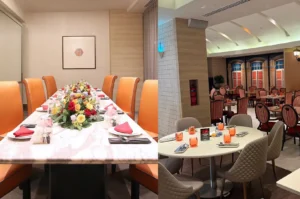
Inside Hanashizuku Japanese Cuisine, the room is warm and low-lit. The izakaya clatter of the building — the shouting, the beer glasses, the laughter — doesn’t reach here. It’s quiet enough that I can hear the knife.
Chef Steven Lee stands behind the counter, and I take a seat where I can watch. He doesn’t look up much. He has been doing this for twenty-eight years, and it shows in the economy of his hands. No wasted motion. The blade moves through a block of tuna in a single unhurried pull, and the slice falls away clean, thick, its edge catching the light.
The sashimi moriawase arrives without ceremony. Fatty tuna. Salmon. A few seasonal cuts I don’t recognise, arranged simply on the plate. The fish came in from Toyosu, flown over on a rhythm the kitchen keeps but never advertises. You can smell it before you taste it — not fishy, but clean, almost like cold seawater. That smell tells you more than any menu could.
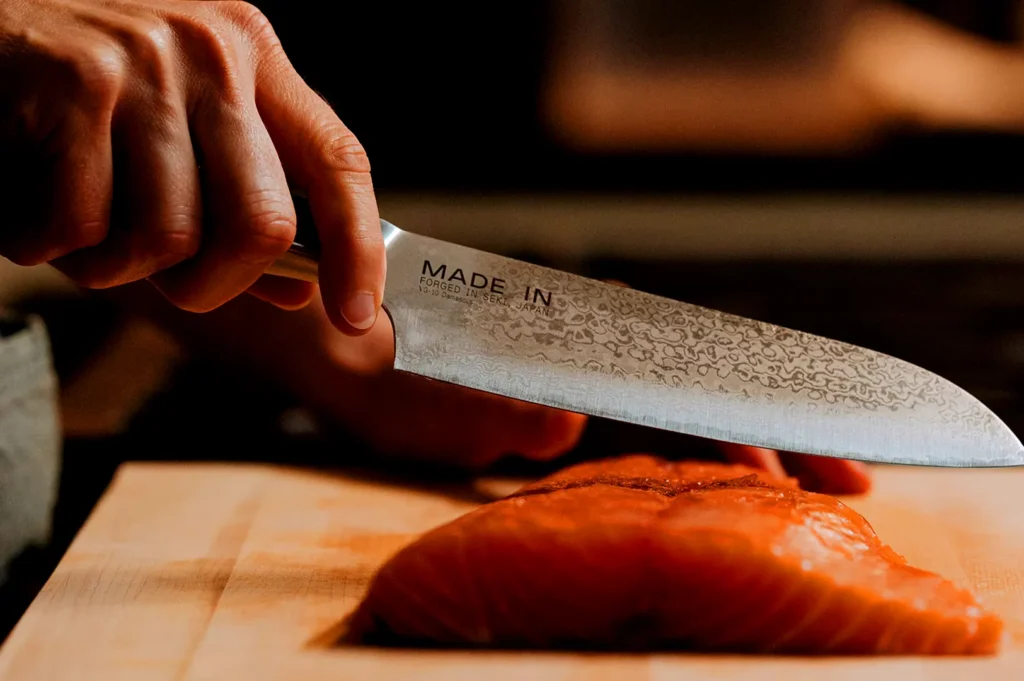
For Eat Drink Asia, this is sashimi at its most honest: Toyosu-fresh cuts that taste like clean seawater.
I take a piece of the tuna. It’s buttery in the way people overuse that word, but here it earns it — soft, giving, dissolving somewhere at the back of the tongue before I’ve decided what to do with it. The salmon is thick, cool, faintly sweet. I slow down. There’s no reason to rush a plate someone spent nearly three decades learning to cut.
What stays with me isn’t the fish, exactly. It’s the quiet. The way a counter like this asks you to pay attention.
There’s a ritual to it that the izakayas outside don’t have. Out there, food is fuel for the evening — loud, communal, fast. Here, it’s something closer to watching. The chef cuts. You eat. Neither of you says much. It’s an old rhythm, and it survives in a corner of a building that doesn’t look like it should hold something so careful.
That’s the part I keep turning over. Hanashizuku sits three floors above a stairwell that hasn’t been renovated in years, in a plaza most people walk past. And inside, a man who has cut fish for twenty-eight years does it the same way he always has, whether the room is full or empty.
There’s a kind of honesty in that mismatch. The setting makes no promises. It doesn’t try to charm you before the food does. Which means the knife has to speak for itself — and it does.
I finish the last slice. Chef Lee is already preparing the next order, the same pull of the blade, the same clean fall of fish.
Outside, the noise waits. In here, for a little while longer, there is only the counter, and the quiet, and the sound of a knife that knows exactly what it’s doing.

Mrs Pho and the Bowl That Makes Somerset Feel Like a Vietnamese Family Table
Eat Drink Asia Team | October 1, 2026
I wasn’t hungry when I walked into 313@somerset. I’d come for something else entirely; an errand, a shop I needed, the usual Orchard rush of people moving faster than the escalators. But somewhere on the first floor, past the noise, I caught the smell of star anise and beef bone, and my feet slowed down…
-
The Carving Knife at Colony, and the Way We Mark What Matters
Eda Wong | September 30, 2026
By Eda Wong for Eat Drink Asia. It’s late morning, and the light is doing most of the work. It pours through the high windows of Colony, at The Ritz-Carlton, Millenia Singapore, spilling across white tablecloths and the vintage prints on the walls. Marina Bay hums somewhere outside, but in here the room feels a…
-
Co Chung Vietnamese Restaurant and the Gỏi Cuốn That Makes Fresh Herbs Do the Work
Dio Asahi | September 29, 2026
I found it by accident, the way you find most things in a mall basement. I’d come down to Plaza Singapura’s B2 for something else entirely, drifting past the usual food-court noise, when I caught the smell of star anise and beef bone coming from a corner. I followed it. And there it was —…
-
Vietnamese Spring Roll: The Recipe That Only Works When the Herbs Stay Awake
Eda Wong | September 26, 2026
Fresh Vietnamese spring rolls, or gỏi cuốn, look delicate, but the recipe is really about control: barely softened rice paper, dry herbs, restrained noodles, clean protein, and a dipping sauce sharp enough to wake the whole thing up. This is not the fried version, chả giò or nem rán. This is the cool, translucent, herb-heavy…
-
Best Steakhouse Singapore: From Fire-Kissed Icons to Old-School Beef Plates
Eat Drink Asia Team | September 24, 2026
I didn’t set out to write about steak. It started with a bad day and a craving for something that pushed back when I bit into it. One dinner turned into a habit, and over a couple of years I found myself at counters, coffeeshops, and dining rooms all over this island, chasing the same…
-
The Ice Counter at Carousel, and the Table Everyone Can Reach
Dio Asahi | September 23, 2026
By Dio Asahi for Eat Drink Asia. It’s a Saturday evening, and someone across the room is carrying a birthday cake. The candles are lit, the walk is careful, and a whole table turns to watch. Plates clink. A child laughs somewhere. The room at Carousel, inside Royal Plaza on Scotts, isn’t quiet — it…
-
Tiong Shian Porridge Centre Review: The Soft Counterweight to Chinatown’s Crisp Toast
Dio Asahi | September 22, 2026
I’d spent the morning with kaya toast. Crisp bread, cold butter, the clean snap of it between my teeth. Good, all of it. But by the time I’d walked a few streets over to New Bridge Road, my mouth wanted the opposite. Something warm. Something that gave way instead of shattering. That’s how I ended…
-
Tong Ah Eating House Review: A Chinatown Breakfast That Still Begins with Kaya Toast
Eda Wong | September 19, 2026
I almost walked past it. I’d been looking for the old triangular building, the red-and-white one you see in every photo of Keong Saik, the one that made Tong Ah feel like a landmark before you’d even ordered anything. But that’s not where it lives anymore. It’s a few doors down now, at 35 Keong…
-
Breakfast at Chinatown Singapore: How Migration Built the City’s Morning Table
Eat Drink Asia Team | September 17, 2026
The first time I ate breakfast in Chinatown, I got it wrong. I arrived at eleven, hungry and hopeful, and found the kopi stalls already turning toward lunch. The porridge uncle was packing up. The toast man had switched to slicing char siew. I ate a rushed plate of noodles standing near a pillar, sweating,…
-
The Bitter Leaf Folded Into a Burmese Home Kitchen
Eda Wong | September 16, 2026
The oil is already hot when she reaches for the leaves. It’s late morning in a kitchen off a quiet lane, and a woman I’ve been watching stands over a blackened wok, tearing bitter gourd leaves by hand into a small heap. The garlic hits the oil first, sharp and loud. Then the leaves go…