Steam rises from the pot, and a woman lifts a banana leaf over the open flame, turning it once, twice, until its stiff green softens and the surface goes glossy and pliant. She wipes it down with a damp cloth, then spoons hot rice into its center while the grains still steam. The leaf releases a green, grassy warmth the moment heat touches it, a scent halfway between cut grass and something sweeter. Her fingers fold the edges in quick, practiced creases, tuck the ends under, and the bundle sits in her palm, warm and sealed, ready to travel.
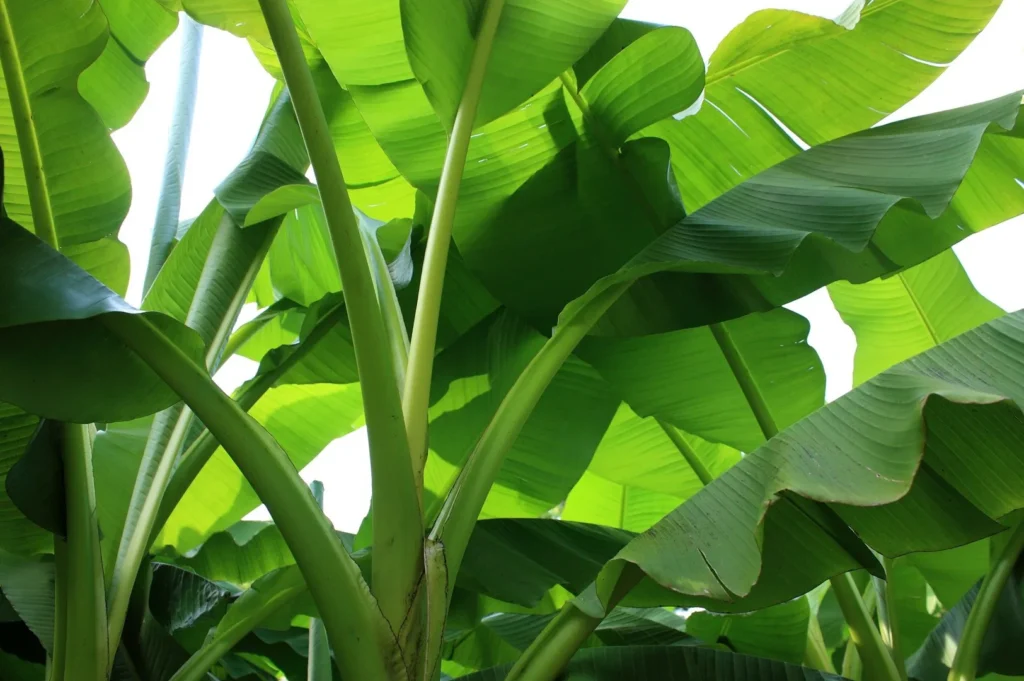
Fresh green banana leaves used for wrapping and steaming rice.
The leaf is daun pisang, pronounced roughly dow-oon pee-sahng, the broad blade of the banana plant used as wrapper, plate, and quiet seasoning all at once. The craft is simple to describe and harder to master. You pass the leaf briefly over flame or hot steam to soften it, because a cold leaf cracks and tears when you fold. You wipe it clean, never wash it heavily, and you wrap the rice while it is still hot.
That heat is the whole point. It coaxes a faint oil from the leaf into the grains, lending a perfume that no pot alone can give. If you’ve ever chased the comforting aroma in a steamed chicken rice recipe, you already know how much fragrance can live in plain grains. The rice comes out with a thin sheen and a smell that clings to your fingers long after the meal.
I have watched grandmothers do this without looking, mid-conversation, the folding so automatic it seems boneless. A wrapped parcel of rice is breakfast at a crowded market, lunch carried into a paddy field, food packed for a long bus ride home. The wrapping is portable warmth, a way to keep rice hot and fragrant for hours without a single container. There is etiquette in the unwrapping too: you peel the leaf back slowly, careful not to lose the grains stuck to its inner face, and you eat with attention to the steam escaping. The folding is often shared labor, several pairs of hands at one table, talking as they work.
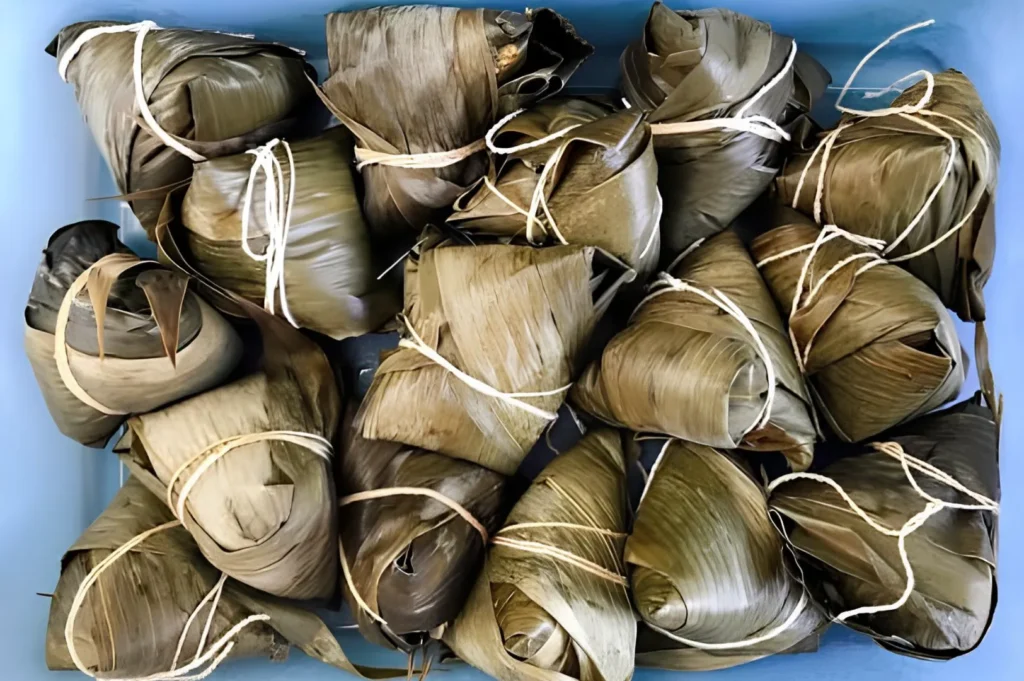
Traditional banana leaf wrapped rice parcels tied with natural string.
What stays with me now is how quietly this is slipping. Plastic and styrofoam wrap faster, seal tighter, cost less in effort. They keep rice hot, yes, but they give nothing back: no scent, no sheen, no green warmth rising when you open the parcel. The leaf asks more of you — a flame, a wiping cloth, hands that know the fold — and in return it seasons the food itself. That exchange, small and unhurried, is exactly what convenience cannot replicate, and exactly what we lose without noticing.
I think of the smell most of all. It is the reason some rice tastes like a particular kitchen, a particular pair of hands, a particular morning you cannot get back.

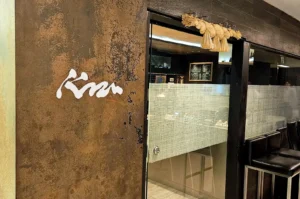
The Same Grill, Three Decades On, at Kazu Sumiyaki Restaurant
Dio Asahi | August 12, 2026
By Dio Asahi for Eat Drink Asia. The lift opens on the fourth floor of Cuppage Plaza and the smoke finds me before the door does. Charcoal, dark and earthy, threaded through with something richer — fat meeting fire. I follow it down a narrow corridor, past shuttered shops and flickering signage, until I reach…
-
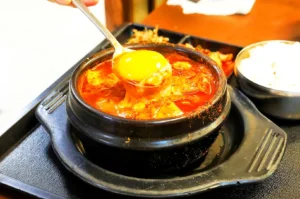
Popular Korean Cuisine Has a Memory: Why Famous Korean Food Feels So Complete
Eat Drink Asia Team | August 11, 2026
The first time I ordered kimchi jjigae in Singapore, I made a small mistake. It came bubbling in a stone pot, and I ate it like soup, spoonful after spoonful, straight down, until my mouth was on fire and the bowl was half gone. The auntie across the counter watched me for a moment, then…
-
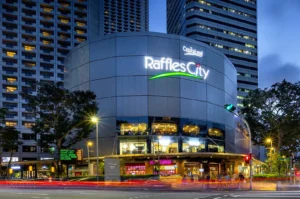
Raffles Place Food Has the Restaurants That Understand the CBD Lunch Rush
Eda Wong | August 8, 2026
I used to think lunch in the CBD was a lost cause. You get an hour, maybe less. The lift takes ten minutes just to reach the ground floor. By the time you’ve queued, ordered, and found a corner to eat in, you’re already checking the clock. For a while, I gave up and just…
-
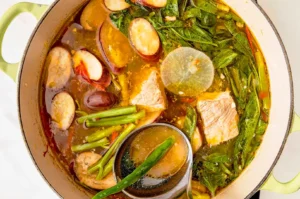
The Tamarind Sourness Inside a Filipino Sinigang Pot
Eda Wong | August 7, 2026
By Eda Wong for Eat Drink Asia. The pot has been going for a while now, and the whole kitchen knows it. Steam curls up from the surface, carrying that sharp-sour smell that reaches you before anything else. It’s not a gentle aroma. It pricks at the back of your throat a little, makes your…
-
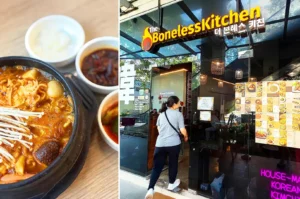
Vegetarian Asian Dishes at The Boneless Kitchen: A Korean Meal Built on Kimchi, Rice, and Restraint
Dio Asahi | August 6, 2026
I didn’t expect to find Korean comfort food in an office building near Tai Seng. But there I was, on a Wednesday a little past 7pm, standing outside The Commerze @ Irving wondering if I’d read the address wrong. This isn’t the part of Singapore you go to for dinner. It’s the part you leave…
-
The Soy Glaze on Kyoto’s Forgotten Rice Crackers
Dio Asahi | August 5, 2026
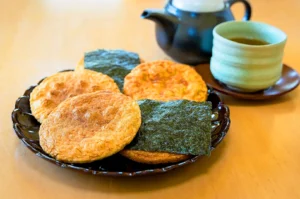
By Dio Asahi for Eat Drink Asia. The old man works close to the coals, and the smell reaches me before I see what he’s doing. Soy meeting heat. That dark, caramel-edged smell that tightens something in your chest. His brush moves in short strokes across a rack of rice crackers, back and forth, patient….
-
Vegetarian Laksa Without the Usual Seafood Shadow: Asian Vegetarian Recipes Begin With the Broth
Eat Drink Asia Team | August 4, 2026
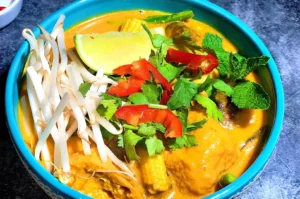
The first vegetarian laksa I made tasted like coconut soup with chilli, not laksa. I thought I was doing it right, stirring paste into warm coconut milk with tofu puffs. It looked the part but lacked depth. Seafood usually provides that depth, prawn shells, dried shrimp, fish cake sweetness. I learned that depth can’t be…
-
A Bowl Built by Hand at Hi Noodle, Three Floors Below Somerset
Eda Wong | July 31, 2026
The escalator carries me down to Basement 3, past the lunch noise of 313 Somerset, and the air changes somewhere along the way. Less mall, more kitchen. The smell finds me first — chilli, vinegar, something warm and sharp that cuts through the perfume of the shops above. Hi Noodle sits there, plain and bright….
-
An Asian Vegetarian Meal at Herbivore Japanese Vegetarian Restaurant: When Japanese Comfort Food Learns a New Body
Eda Wong | July 30, 2026
I didn’t grow up eating eel. But I grew up watching my grandmother turn one thing into another — gluten into “duck,” beancurd skin into “fish,” mushrooms into something that tasted of the sea without ever touching it. Buddhist vegetarian cooking does that. It doesn’t pretend so much as it remembers, building familiar shapes out…
-
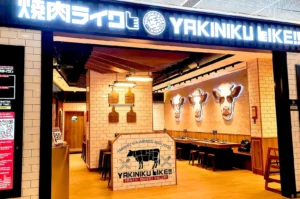
A Table for One, and a Grill That Belongs to You in Yakiniku Like
Dio Asahi | July 29, 2026
The grill glows orange in front of me before the meat arrives. It’s a small thing, set into the counter at my single seat, and it hums faintly under the chatter of the room. No flame. No charcoal. Just a low electric warmth I can feel rising toward my face. A plate comes. Thin slices…