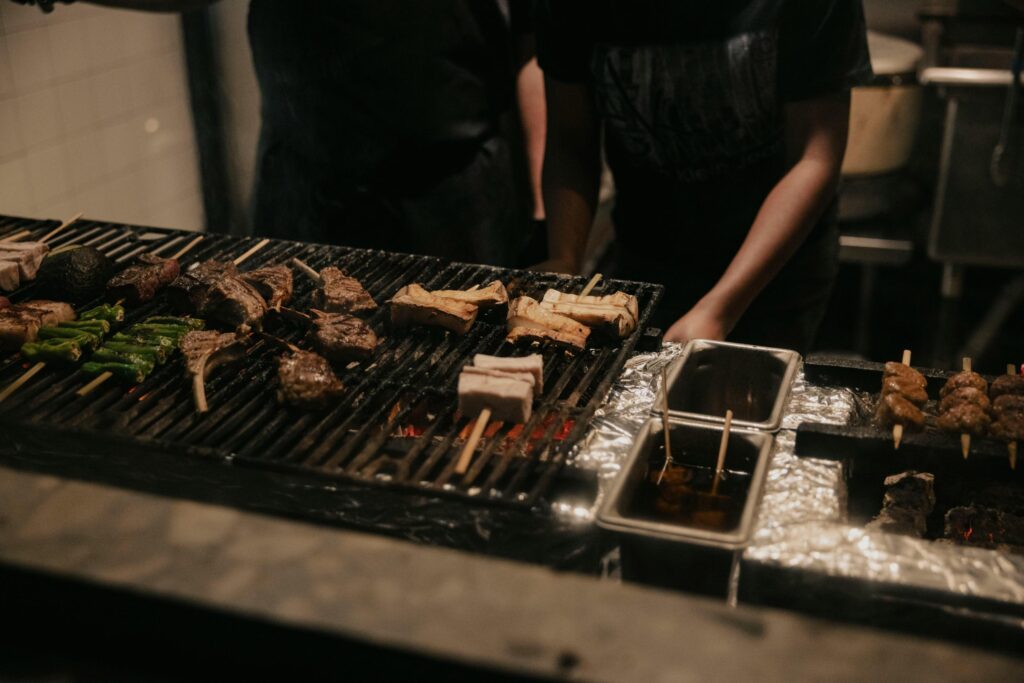
The first thing I noticed was the smoke.
It didn’t rise all at once, but in thin, steady ribbons that curled upward from a narrow grill set just inches from the counter. The scent came first, warm and unmistakable, a mix of rendered chicken fat and binchōtan charcoal, clean but deeply present. Inside the small shop in Osaka, space felt compressed, not uncomfortably, but deliberately. A few stools lined the counter, close enough that you could hear the faint crackle of the coals and the quiet turn of skewers being rotated by hand. There was no menu in sight, only a sequence unfolding in front of you, one skewer at a time.
Yakitori, at its core, is straightforward. Chicken, skewered, seasoned, and grilled over charcoal. But in places like Osaka, it takes on a rhythm that feels more considered than casual. The skewers move in a quiet progression, beginning with lighter cuts, then gradually deepening in flavour and richness. Negima, with its alternating pieces of chicken and scallion, gives way to tsukune, a hand-formed meatball glazed lightly with tare. Each arrives without announcement, placed directly onto the counter, still warm, sometimes brushed once more with sauce before it leaves the grill.
Discover more about Japan’s food philosophy and culinary harmony here: https://eatdrinkasia.com/japan-food-culture-culinary-harmony/
What defines yakitori is not just the ingredients, but the way each part of the chicken is used with intent. Skin, liver, cartilage, even the tail, each prepared to highlight texture as much as flavour. There is a long-standing practice here of whole utilisation, rooted less in trend and more in habit. The technique itself relies heavily on control. Binchōtan charcoal burns at a high, steady heat, allowing the exterior to char lightly while keeping the interior tender. Seasoning is minimal, often just salt or tare, but applied at precise moments during grilling to build layers rather than overwhelm.
There is a quiet discipline in how the process unfolds. The chef’s attention never strays far from the grill, adjusting distance, turning skewers, watching for small shifts in colour and texture. It is a practice built on repetition, where consistency carries more weight than variation. The result is not dramatic, but exact. Each skewer arrives as it should, neither rushed nor held too long, shaped by timing that feels almost instinctive.
What makes yakitori stand out is this balance between simplicity and precision. It does not rely on complexity to create depth. Instead, it draws from familiarity, refining it through technique and attention. There is no attempt to reinterpret or elevate it beyond recognition. If anything, its strength lies in how closely it holds to its form, allowing small adjustments in heat, seasoning, and timing to define the experience.

STR TAO Taiwan Cuisine and the Comfort of a Menu That’s Too Big to Be Lazy: Food Places Nearby
Eat Drink Asia Team | July 25, 2026
It was the kind of evening where you don’t want to think too hard about dinner. I’d been walking up East Coast Road, the air still thick from an afternoon shower, when I ducked into a coffeeshop just to sit down. The Bullion Hawker Bar. And tucked among the usual suspects — wanton mee, Hokkien…
-
Sesame Oil at the End: Finishing, Not Flavoring
Eda Wong | July 24, 2026
The wok is already off the heat. The greens sit glossy and dark, steam still curling off them. My mother lifts a small bottle, tilts it, and lets a thin line of sesame oil fall across the top. It hisses faintly against the warm leaves, and the smell rises all at once — toasted, nutty,…
-
Long Phung Vietnamese Cuisine, Where the Menu Doesn’t Waste Words: A Good Restaurant Close to Me
Eda Wong | July 23, 2026
I came in from the rain on a Tuesday, somewhere past 8pm, hungry and a little defeated by the day. The fan was clacking. A queue of three or four people stood near the doorway, dripping. Someone shouted an order toward the kitchen in Vietnamese, and a bowl of pho slid onto a nearby table…
-
The First Squeeze of Calamansi in a Noodle Stall Bowl
Dio Asahi | July 22, 2026
The bowl lands in front of me, broth still trembling from the walk across the stall. Steam rises and fogs the edge of my glasses. To the side sits a small dish of calamansi halves, cut and waiting, their skins slick under the fluorescent light. I pick one up. It gives slightly between my fingers,…
-
Isshin Machi East Coast: Where Comfort Food Turns Addictive
Dio Asahi | July 21, 2026
Let me clear up the first puzzle right away. The name “Isshin Machi” sounds unmistakably Japanese, and I’ll admit I walked in half-expecting ramen and gyoza. What I found instead was a Taiwanese kitchen, plates of lu rou fan, braised beef noodles, and golden fried chicken that trace straight back to the island’s home cooking….

Best Cafe Singapore: A Map of Brunch Plates, Quiet Corners, and Dangerous Pastries
Dio Asahi | July 18, 2026
I didn’t set out to make a list. I made a habit. Over the years, cafes became the places I went to think, to wait out the rain, to sit with a coffee I didn’t have to rush. Some I returned to for the food. Others, I returned to for the feeling — the way…
-
Pickled Mustard Greens: The Sour Note in Clear Broth
Eda Wong | July 17, 2026
Steam lifts from a bowl of clear pork broth, and a spoonful of chopped pickled greens slides in. The broth shifts at once, its richness suddenly cut by a sharp, clean sourness that sits high and bright on the tongue. The greens have softened in the heat but keep a faint, springy crunch. Someone leans…
-
The Potato Curry That Teaches You How Spices Wake Up: A Beginner’s Indian Cooking Lesson
Eda Wong | July 16, 2026
The first time I made aloo curry on my own, I burned the cumin. I remember standing in my tiny HDB kitchen, watching those little seeds go from golden to black in what felt like one breath, and thinking: this is harder than it looks. But here’s what that bitter, smoky disaster taught me, the…
-
Bamboo Skewers and Smoke: Street Grills in Chiang Mai
Dio Asahi | July 15, 2026
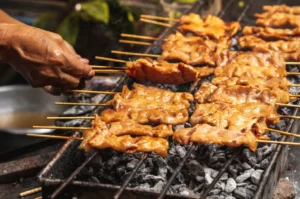
The cart glows at the edge of the lane just as the heat of the day finally loosens. A woman fans the coals with a flattened piece of cardboard, and the embers brighten orange under a row of skewers. Fat slides off the pork, hits the charcoal, and hisses upward in a thin curl of…
-
Chana Masala With Warm Roti, Built for Weeknights: Quick Vegetarian Dinner Recipes Indian
Dio Asahi | July 14, 2026
The first time I made chana masala, I started with dried chickpeas at 7:30 on a weeknight, soaking and boiling like the recipe said. By the time the curry was actually done, it was nearly ten and I’d already eaten half a loaf of bread out of sheer hunger. That night taught me something I…