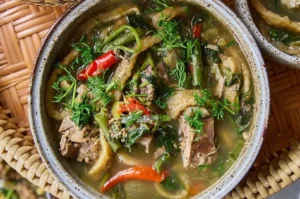
Steam lifts from a bowl of clear pork broth, and a spoonful of chopped pickled greens slides in. The broth shifts at once, its richness suddenly cut by a sharp, clean sourness that sits high and bright on the tongue. The greens have softened in the heat but keep a faint, springy crunch. Someone leans over the pot, breathes in, and adds another small handful, tasting after each one. The smell is unmistakable: tangy, slightly funky, alive in a way fresh vegetables never are. It is a small adjustment, almost invisible, and it changes everything in the bowl.
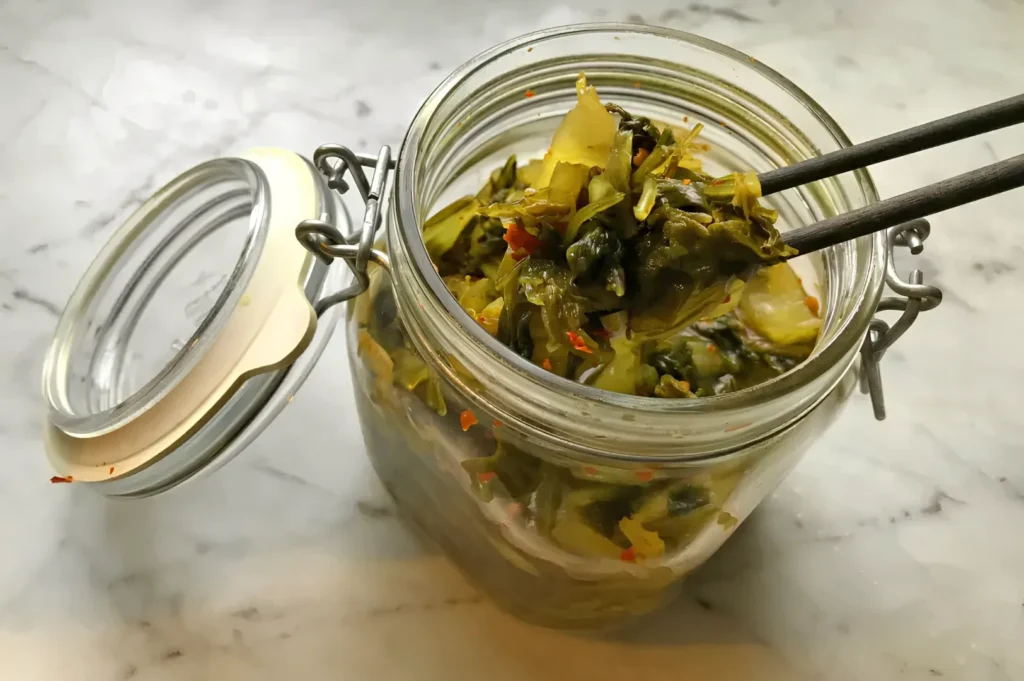
These are pickled mustard greens, known across regions as suancai (pronounced roughly swan-tsai), or as cải chua, or pak gard dong. The making is humble. Whole mustard greens are washed, salted, and pressed under a weight, then left to ferment in their own brine until the leaves turn translucent and deeply sour. Time does the work. A few days yields a gentle tang; longer brings a sharper, more pungent edge. Before they go into broth, the greens are usually rinsed and squeezed, a quiet act of calibration that decides how much sourness the cook wants. Too little rinsing and the soup turns aggressive; too much and the brightness disappears. In a clear broth, the greens do one thing perfectly: they lift fat, sharpen flavor, and keep the whole bowl from feeling heavy.
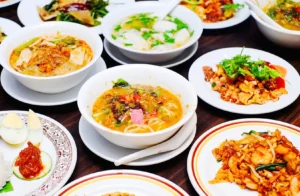
I learned this watching my grandmother tend her jar on the kitchen ledge, pressing the leaves down each evening with the flat of her hand. She never measured. She tasted the brine on a fingertip and knew. That jar was a household clock of sorts, a thing checked daily, replenished when it ran low, drawn from for noodle breakfasts and weekend soups. The greens were never the centerpiece. They were the note that made the rest make sense, the sour thread running through ordinary meals. It felt inseparable from an asian communal dining tradition—a shared table where one person’s careful jar quietly tuned everyone’s bowl. Whole families calibrated their cooking around one cook’s particular fermentation, a private standard passed hand to hand, rarely written down, often slightly different from the household next door.
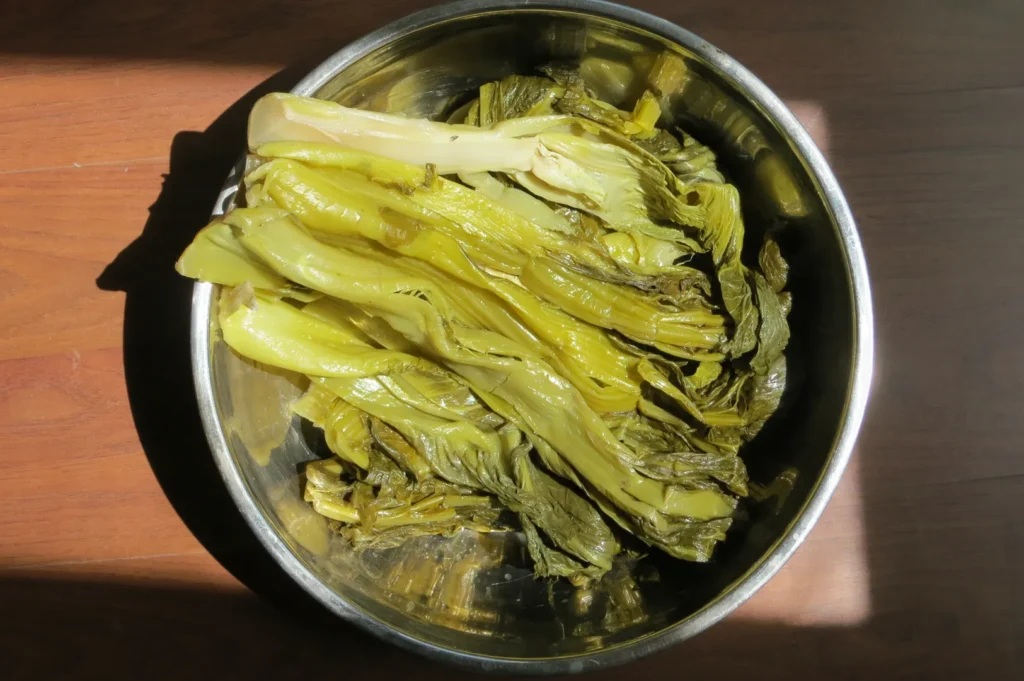
What stays with me now is how easily that calibration slips away. Factory-fermented greens fill the shelves, sealed in bright packets, consistent and convenient. They save the salting, the pressing, the daily tasting. But they arrive at a single fixed sourness, decided by a machine, not by a hand reading the brine. The skill of adjusting sour to suit a particular broth, a particular evening, a particular person’s tongue, fades when the jar disappears from the ledge. We gain ease. We lose the small, attentive judgment that made each bowl personal.
I think of that finger dipped in brine. It asked nothing of anyone, yet it carried a whole way of cooking—a quiet fluency in time and salt that a kitchen keeps alive only by tending it, day after day.

Cuppage Plaza Food: Hidden Japanese Restaurants and Dining Gems Near Orchard
Dio Asahi | June 20, 2026
Orchard Road is a brilliant, trend-setting celebration of flavours, but its gleaming mega-malls can sometimes feel a bit predictable. If you are an urban food enthusiast seeking genuine culinary journeys rather than polished franchise menus, the true heart of the district lies slightly hidden. Cuppage Plaza is a fascinating, liminal space that operates almost like…
-
Makgeolli Bowls and the Soft Grain of Korean Rice Wine
Eda Wong | June 19, 2026
The monsoon rain drums a steady, heavy rhythm against the fogged windows of a narrow tavern in Jongno, muffling the chaotic pulse of the city outside. Inside, the air hangs warm, thick with the scent of toasted mung beans and a subtle, yeasty tang. A dented brass kettle tips forward, and a chalk-white, opaque liquid…

Kung Pao Chicken Sauce Is the Real Test: Why It Turns Glossy, Sharp, and Addictive
Eat Drink Asia Team | June 18, 2026
Kung pao chicken is often described by its main ingredients: diced chicken, dried chillies, peanuts, spring onions, and Sichuan peppercorns. But anyone who has cooked it at home knows the truth: the dish succeeds or fails because of the sauce. The sauce decides whether kung pao chicken tastes lively and balanced, or flat, sticky, and…
-
Jeju’s Seaweed Soup and the Memory of Birthday Tables
Dio Asahi | June 17, 2026
The sharp winter wind rattles the low stone walls of a Jeju Island kitchen, but inside, the air is thick with steam and the deeply marine scent of boiling kelp. An elderly woman stands by a bubbling steel pot, watching the dark green fronds swell and twist in the rolling water. She adds a splash…
-
Chicken Pao Recipe for People Who Respect Heat: Why Kung Pao Works Only When Timing Is Tight
Eda Wong | June 16, 2026
I remember my first attempt at cooking gong bao ji ding a few years ago. I wanted to recreate that authentic, trend-setting dish I had experienced at a traditional Sichuan restaurant, a meal that felt like a genuine celebration of flavours. I heated my wok until it was smoking, tossed in a handful of dried…
-
A Shu Yan Sichuan Cuisine Review Written in Pepper and Smoke: Chicken Pao That Wakes Up the Table
Dio Asahi | June 13, 2026
I used to think of authentic Sichuan food as a sheer test of endurance. For a long time, I assumed the goal was simply to survive the fiery onslaught of chillies rather than actually taste anything. But my recent culinary journey at Shu Yan Sichuan Cuisine completely rewired how I understand this region’s flavour map….
-
In Luang Prabang, Or Lam Carries the Taste of Sakhan
Eda Wong | June 12, 2026
The damp morning mist still clings to the teakwood houses of Luang Prabang as an elderly cook tends to a glowing charcoal brazier. Sparks jump lightly into the cool air, illuminating the blackened belly of an aluminium pot. Inside, a thick, dark liquid bubbles rhythmically, releasing an incredibly aromatic cloud of charred lemongrass, sweet Thai…
-
The Malayan Council, Reviewed: Local Food in Malaysia, Plated Like a Memory
Eat Drink Asia Team | June 11, 2026
Our Eat Drink Asia team spends a lot of time debating what makes a truly unforgettable meal. The team has previously published articles exploring the redefinition of comfort food. That is exactly what led me to The Malayan Council at 71 Bussorah Street. I visited on a Friday around 7:30 pm, just as the weekend…
-
Sushi in Singapore: Why There Is a Style for Every Budget
Eda Wong | June 11, 2026
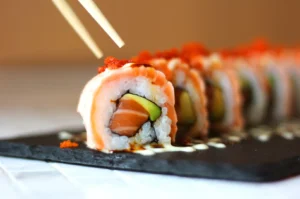
Few Japanese dishes have travelled as successfully across Asia as sushi. What began as a culinary tradition deeply rooted in Japan has evolved into something remarkably diverse in Singapore. Today, sushi in Singapore can mean many different things. It can be a quick lunch grabbed from a conveyor belt restaurant, a carefully curated omakase meal…
-
The Quiet Pull of Lahpet in Myanmar’s Tea Leaf Salad
Dio Asahi | June 10, 2026
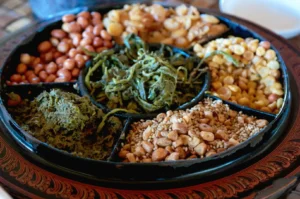
The afternoon humidity presses against the open-air teahouse in downtown Yangon, where the sharp clatter of a silver spoon against ceramic cuts through the low hum of conversation. A small plate sits in the centre of a low plastic table, holding a dense, dark green cluster that smells faintly of damp earth and sharp lime….