Steam lifts from a bowl of clear pork broth, and a spoonful of chopped pickled greens slides in. The broth shifts at once, its richness suddenly cut by a sharp, clean sourness that sits high and bright on the tongue. The greens have softened in the heat but keep a faint, springy crunch. Someone leans over the pot, breathes in, and adds another small handful, tasting after each one. The smell is unmistakable: tangy, slightly funky, alive in a way fresh vegetables never are. It is a small adjustment, almost invisible, and it changes everything in the bowl.
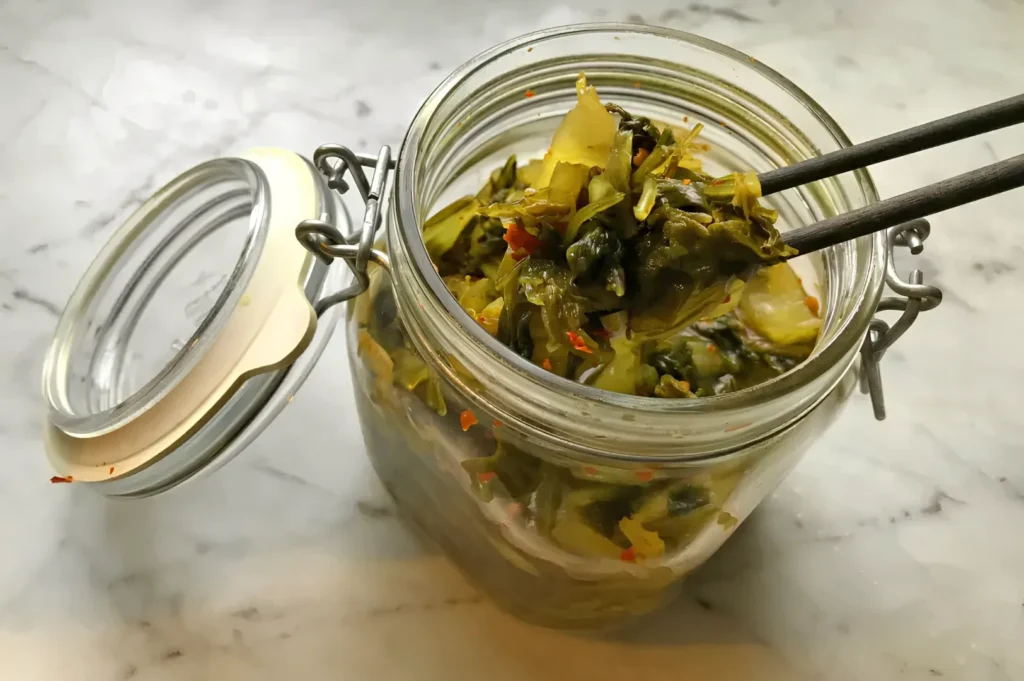
These are pickled mustard greens, known across regions as suancai (pronounced roughly swan-tsai), or as cải chua, or pak gard dong. The making is humble. Whole mustard greens are washed, salted, and pressed under a weight, then left to ferment in their own brine until the leaves turn translucent and deeply sour. Time does the work. A few days yields a gentle tang; longer brings a sharper, more pungent edge. Before they go into broth, the greens are usually rinsed and squeezed, a quiet act of calibration that decides how much sourness the cook wants. Too little rinsing and the soup turns aggressive; too much and the brightness disappears. In a clear broth, the greens do one thing perfectly: they lift fat, sharpen flavor, and keep the whole bowl from feeling heavy.
I learned this watching my grandmother tend her jar on the kitchen ledge, pressing the leaves down each evening with the flat of her hand. She never measured. She tasted the brine on a fingertip and knew. That jar was a household clock of sorts, a thing checked daily, replenished when it ran low, drawn from for noodle breakfasts and weekend soups. The greens were never the centerpiece. They were the note that made the rest make sense, the sour thread running through ordinary meals. It felt inseparable from an asian communal dining tradition—a shared table where one person’s careful jar quietly tuned everyone’s bowl. Whole families calibrated their cooking around one cook’s particular fermentation, a private standard passed hand to hand, rarely written down, often slightly different from the household next door.
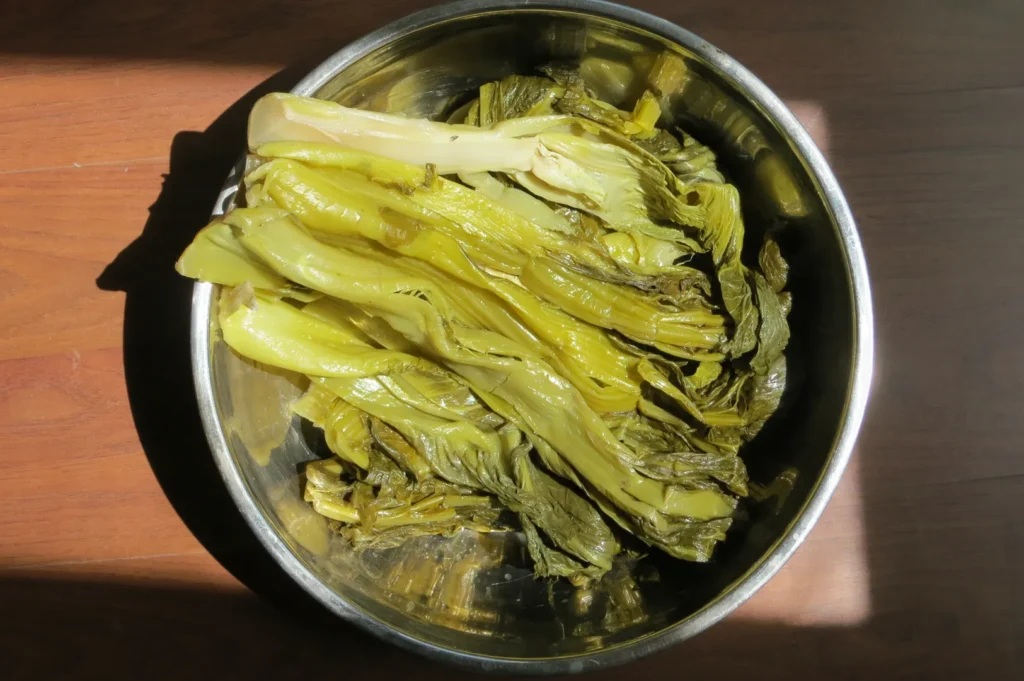
What stays with me now is how easily that calibration slips away. Factory-fermented greens fill the shelves, sealed in bright packets, consistent and convenient. They save the salting, the pressing, the daily tasting. But they arrive at a single fixed sourness, decided by a machine, not by a hand reading the brine. The skill of adjusting sour to suit a particular broth, a particular evening, a particular person’s tongue, fades when the jar disappears from the ledge. We gain ease. We lose the small, attentive judgment that made each bowl personal.
I think of that finger dipped in brine. It asked nothing of anyone, yet it carried a whole way of cooking—a quiet fluency in time and salt that a kitchen keeps alive only by tending it, day after day.

Dining at Suntec: The Restaurants That Feel Like Different Cities in One Mall
Eda Wong | June 9, 2026
Over the past six months, I’ve navigated the sprawling, sometimes disorientating corridors of Suntec City more times than I can count. What started as a simple quest to find decent spots for post-meeting lunches quickly turned into a genuine culinary journey. I have tried over a dozen venues within this massive complex, and I’ve found…
-
PappaRich SG and the Comfort of Malaysian Staple Food: A Restaurant Review in Familiar Flavours
Dio Asahi | June 6, 2026
There is a very specific kind of exhaustion that hits you right before a flight or just after you land. You are dragging your suitcase, staring blankly at the departure boards, and suddenly, you realize you are starving. But you don’t want just any food. You want something warm, familiar, and deeply comforting. I felt…
-
Sri Lanka’s Ambul Thiyal and the Sourness of Goraka
Eda Wong | June 5, 2026
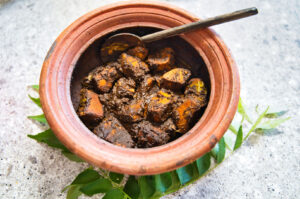
In the open-air kitchen of a coastal home in southern Sri Lanka, a low fire crackles under a wide, unglazed clay pot. The air is thick with the scent of roasted black pepper and something deeply, aggressively tart. A wooden spoon scrapes the bottom of the pot, turning cubes of firm yellowfin tuna until they…
-
Traditional Malaysian Foods Aren’t a Museum: They’re a Living Argument at the Table
Eda Wong | June 4, 2026
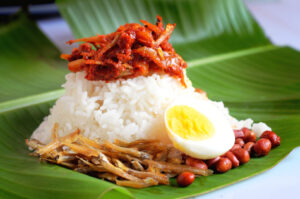
When I first really started digging into traditional Malaysian food, I made a classic rookie mistake. I was sitting at a crowded kopitiam in Kuala Lumpur, looking at a plate of nasi lemak, and I thought I understood exactly what it was supposed to be. I thought it was a fixed, rigid recipe, a museum…
-
In Gifu, Hoba Miso Warms Slowly Over Magnolia Leaves
Dio Asahi | June 3, 2026
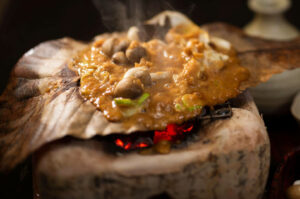
Frost clings to the wooden window frames in the highlands of Gifu. Inside, the air is thick with the scent of woodsmoke and fermented soybeans. On the table, a small ceramic charcoal grill known as a shichirin radiates a gentle, localized heat. Resting directly above the glowing embers is a large, brittle brown leaf holding…
-
The Stir Fried Egg Plant That Taught Me Restraint at Si Chuan Dou Hua Restaurant
Eat Drink Asia Team | June 2, 2026
I’ve always had a love-hate relationship with Sichuan food. Usually, you walk into a spot, order your food, and spend the rest of the night sweating through your shirt, chugging ice water, and wondering why you did this to yourself. But when I visited Si Chuan Dou Hua Restaurant on a Tuesday around 7 pm,…
-
What the Wok Is Really Doing to the Vegetable: The Question Behind Every ‘Brinjal Recipe Chinese Style’
Dio Asahi | May 30, 2026
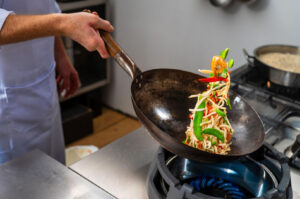
When I first tried cooking brinjal at home, I was completely convinced that all I needed was a hot pan, some oil, and a good recipe. I chopped the vibrant purple vegetable, threw it into a standard frying pan with a generous pour of oil, and waited for the magic to happen. Instead of the…
-
The Clay Pot Rice Crust That Hong Kong Cooks Wait For
Eda Wong | May 29, 2026
The December wind cuts sharply through the narrow alleys of Temple Street, but the ambient heat from the glowing charcoal stoves pushes the chill away. A cook stands before a long row of blackened clay pots, working with a rhythmic, almost meditative focus. Plumes of white steam rise into the night air, carrying the heavy,…
-
The Velvet Logic Behind a Chinese Eggplant Recipe: When ‘Eggplant Recipes Asian’ Means Silk
Eda Wong | May 28, 2026
I vividly remember standing over my stove a few years ago, staring into a wok full of what can only be described as a greasy, grey disaster. When I first tried this dish at home, I assumed that tossing chopped eggplant into a hot pan with a generous glug of cooking oil would naturally yield…
-
Cambodia’s Prahok Pots and the Ferment Beneath the Meal
Dio Asahi | May 27, 2026
The afternoon heat in the outskirts of Phnom Penh settles like a thick blanket over the wooden stilt houses. Underneath the corrugated tin roof of an open-air kitchen, the air carries a heavy, sharp scent that instantly commands attention, a deeply pungent, earthen aroma of crushed fish and salt. An elderly woman sits on a…