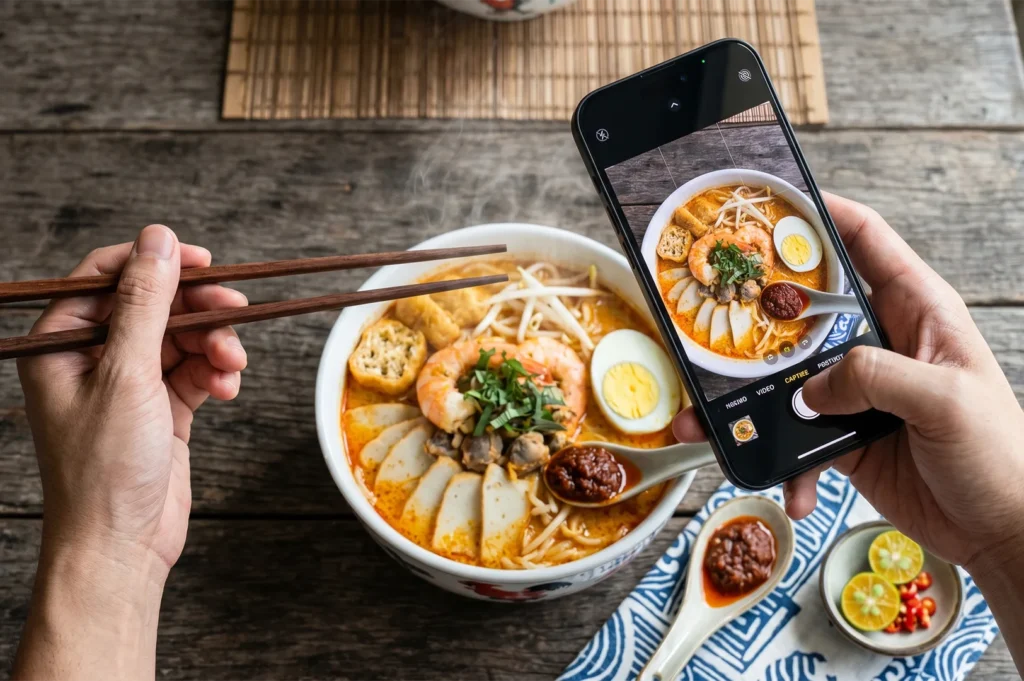
In our first, would probably say, emotional editorial, I would like to open with how there is a particular kind of silence that happens before a dish is eaten now. Not the quiet of anticipation, but the pause of positioning, a hand hovering just above the plate, adjusting the angle of a bowl so the light catches the surface just right. Somewhere between the kitchen and the first bite, food has learned to wait.
I have been a food blogger for a while now, and this topic has a special place in my heart. Because we have watched this shift happen gradually. A bowl of noodles is no longer simply hot and immediate, it is framed. A slice of cake is no longer just soft and sweet, it is cut, rearranged, sometimes rebuilt for the photograph. In this space between aesthetic and appetite, the modern food blogger operates.
At its best, this attention to beauty does something meaningful. SG Food Blogger, and of course us here in Eat Drink Asia, believes that it slows us down and asks us to look closely, to notice the sheen of a sauce or the uneven edges of something handmade. These details carry memory, especially in dishes shaped by long-standing recipes and quiet traditions. In these moments, the visual becomes a form of respect.
But there is a quiet tension underneath. What is being preserved is often not the food itself, but a version of it, styled and adjusted before it is shared. The dish that is eventually eaten is no longer the same one that was captured. It has cooled, settled, and shifted, becoming something slightly removed from its original state.
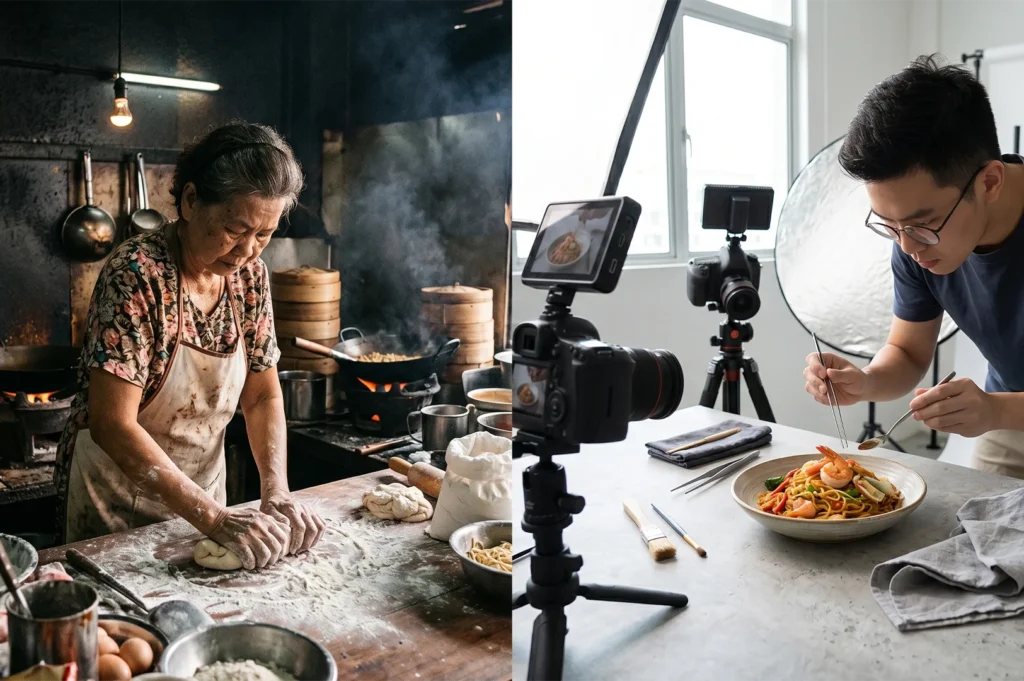
And in that shift, appetite becomes secondary. Food in hawker stalls, family kitchens, and small specialty spaces was never meant to wait. It was built on timing, on being eaten at the exact moment it reaches its peak. To delay that moment is to change the experience.
Yet documentation has also become a form of preservation. Many dishes today are fragile not in texture, but in continuity. Recipes are simplified, techniques forgotten, and entire food traditions begin to fade as the people behind them grow older. In this sense, the camera becomes a tool of memory.
But memory, shaped by aesthetic expectation, begins to change. Colours are adjusted, portions curated, complexity reduced into something more visually clear. A layered dish becomes a clean image, easier to understand but further from how it truly exists.
We see this most clearly in how recipes travel. Traditional preparations are reworked into quicker, simpler versions. Adaptation is not new, it has always been part of how food survives. But there is a point where reduction begins to remove what made the dish whole.
Some food bloggers resist this pressure. They allow dishes to remain slightly uneven, imperfect, and real. Their work feels closer to the act of eating, less controlled but more honest. They remind us that food is not meant to stay still, but to move and be consumed.
Perhaps the balance lies here. Not in rejecting beauty, but in placing it beside appetite rather than ahead of it. A dish is not complete when it is photographed, but when it is eaten. If we are to preserve food meaningfully, we must remember that the recipe is not the image, and the specialty is not the styling. The experience, always, comes after.

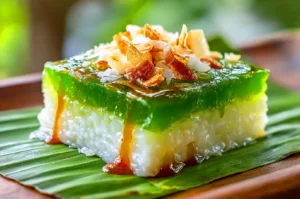
The Coconut Spoon That Shapes Nyonya Kueh Salat
Eda Wong | August 21, 2026
By Eda Wong for Eat Drink Asia. Steam curls up from a tray in the back of the kitchen, and the whole room smells green. Pandan, crushed and knotted, pushed through wet cloth until the leaves give up their colour. An auntie leans over the tray with a spoon carved from coconut shell, dark and…
-
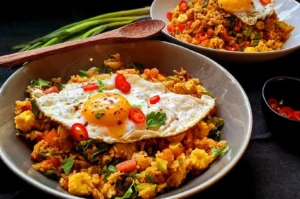
Chicken Nasi Goreng Recipe: What Leftover Rice Becomes After the Wok Gets Serious
Dio Asahi | August 20, 2026
There’s a container of rice at the back of my fridge most weeks. Cold, a little hard, forgotten from a dinner two nights ago. Some people see that and think of waste. I see the start of something better. Because leftover rice doesn’t want to be reheated. It wants to be fried. And when it…
-
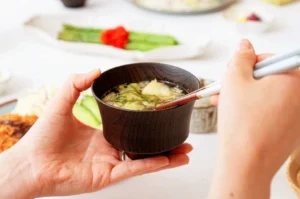
The First Ladle of Miso Soup in a Tokyo Breakfast Shop
Dio Asahi | August 19, 2026
By Dio Asahi for Eat Drink Asia. The shop is barely wider than a hallway. Seven stools, a counter worn smooth, and behind it a woman ladling soup into small ceramic bowls before anyone has ordered it. Steam lifts off the surface and fogs the window against the cold morning. The bowl reaches me warm…
-
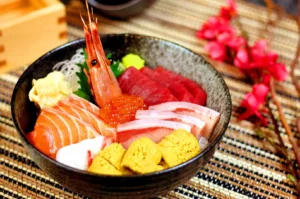
Chirashi Don Best Picks When Bowls Between the Sushi Counter and Lunch Are the Current Mood
Eat Drink Asia Team | August 18, 2026
There’s a specific kind of hunger that a chirashi don answers. It’s not the hunger for a full sushi omakase, with its slow ceremony and its quiet counter watching. And it’s not the hunger for something thrown together and forgotten by three o’clock. It sits somewhere in between, fish and rice in one bowl, cool…
-
Kopi Through the Cloth: Why the Strain Matters
Eda Wong | August 17, 2026
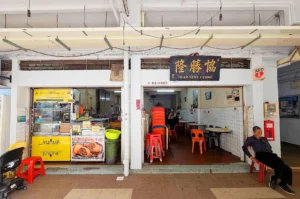
By Eda Wong for Eat Drink Asia. It is not yet seven, and the uncle at Heap Seng Leong has the pot going. He works the sock strainer over the tin cup with both hands, dipping and lifting, dipping and lifting, coaxing the coffee through the worn cloth. Steam rises between his fingers. The smell…
-
SBCD Korean Tofu House and the Comfort Logic of Bubbling Soondubu
Eda Wong | August 15, 2026
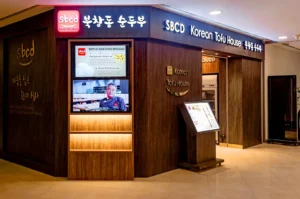
It was raining the afternoon I went. Not the polite kind, the sort that drums against the glass of Guoco Tower and makes you glad you’re already underground. I hadn’t planned on soondubu. I’d planned on something quick, something I could eat between the errands piling up in my head. But the rain does something…
-
The Knife Work at Hanashizuku Japanese Cuisine, Three Floors Above the Noise
Eda Wong | August 14, 2026
By Eda Wong for Eat Drink Asia. The lift doors open on a floor of Cuppage Plaza that has seen better decades. Peeling signage. A corridor that smells faintly of old carpet and cigarette smoke drifting from somewhere. Then a door slides shut behind me, and the noise falls away. Inside Hanashizuku Japanese Cuisine, the…
-
Todamgol Restaurant and the Comfort Logic Behind Famous Korean Foods
Dio Asahi | August 13, 2026
It was close to nine on a Friday when I finally found the door. Tanjong Pagar was doing its usual thing, full tables spilling onto five-foot ways, soju bottles catching the light, someone laughing too loudly two doors down. I almost walked past Todamgol. Then the smell reached me. Fermented, smoky, a little sharp. The…
-
The Same Grill, Three Decades On, at Kazu Sumiyaki Restaurant
Dio Asahi | August 12, 2026
By Dio Asahi for Eat Drink Asia. The lift opens on the fourth floor of Cuppage Plaza and the smoke finds me before the door does. Charcoal, dark and earthy, threaded through with something richer — fat meeting fire. I follow it down a narrow corridor, past shuttered shops and flickering signage, until I reach…
-
Popular Korean Cuisine Has a Memory: Why Famous Korean Food Feels So Complete
Eat Drink Asia Team | August 11, 2026
The first time I ordered kimchi jjigae in Singapore, I made a small mistake. It came bubbling in a stone pot, and I ate it like soup, spoonful after spoonful, straight down, until my mouth was on fire and the bowl was half gone. The auntie across the counter watched me for a moment, then…