By Eda Wong for Eat Drink Asia.
Steam curls up from a tray in the back of the kitchen, and the whole room smells green. Pandan, crushed and knotted, pushed through wet cloth until the leaves give up their colour. An auntie leans over the tray with a spoon carved from coconut shell, dark and worn smooth at the edges from years of the same motion. She pours the custard slowly, tilting the spoon so the pale jade batter runs across the rice without breaking it. She doesn’t rush. The rice below has already set, packed tight and glossy. Her hand moves like she’s done this ten thousand times, because she has.
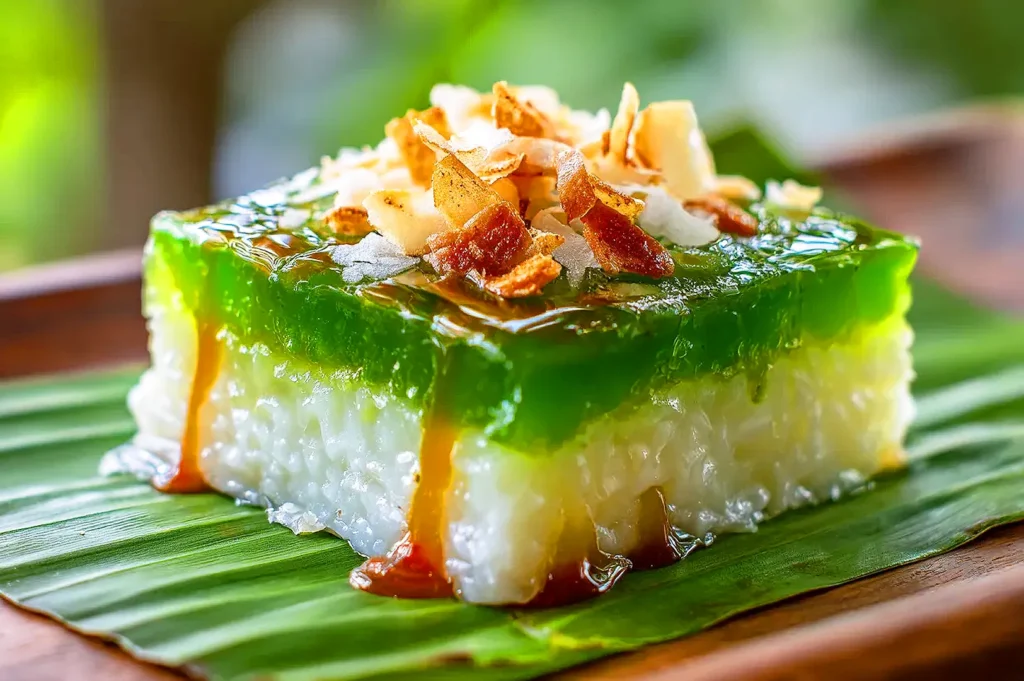
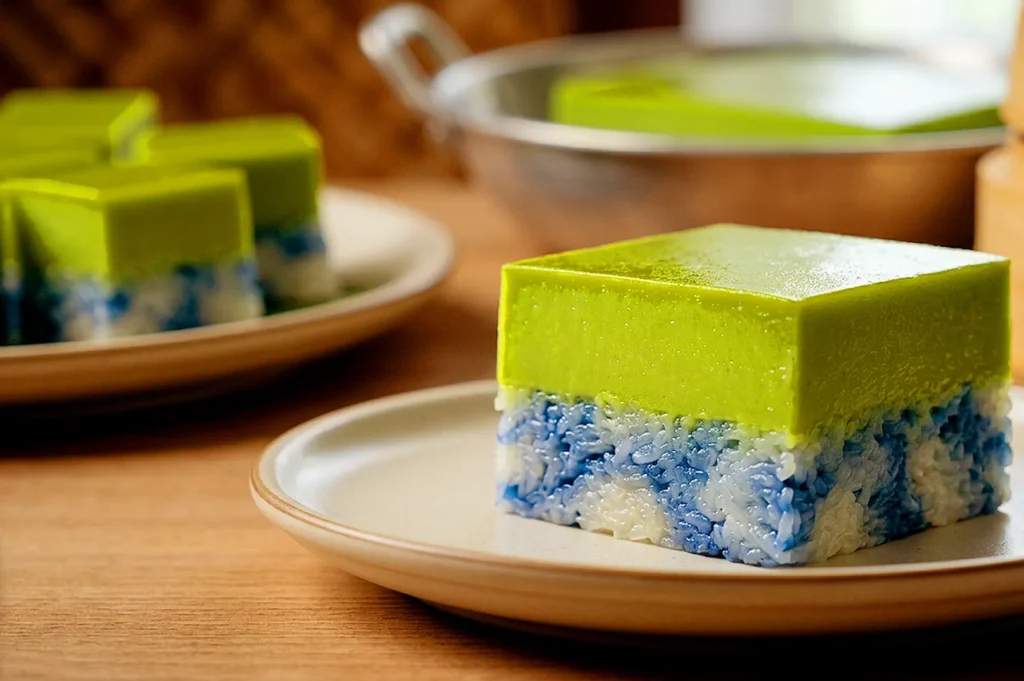
What she’s making is kueh salat, said roughly “kweh sah-lat,” a two-layered Peranakan steamed cake. The base is glutinous rice, cooked with coconut milk until each grain sits close against the next, firm enough to hold. On top goes the custard — pandan and coconut and egg, steamed until it just sets, soft but not loose. The colours matter: white rice below, that deep pandan green above.
The coconut spoon is the quiet hero here. Metal scrapes and cuts; a coconut-shell spoon is gentle. It lets the custard slide over the rice in thin, even layers, so the two halves meet cleanly instead of bleeding into each other. Pour too fast, or too hot, and the layers muddy. The custard has to go on warm and unhurried, one patient ladle at a time.
You learn this in a home kitchen, not a class.
Kueh like this was made for occasions — weddings, Lunar New Year, prayers, the long afternoons before a gathering. In Peranakan households, it was the women who held this knowledge. Mothers and grandmothers and aunties, hands stained pandan-green, passing down not recipes on paper but the feel of a thing. How firm the rice should press. How the custard should wobble when it’s ready. Knowledge kept in muscle and memory, taught by standing beside someone at the stove until your hands knew it too.
There’s a shortcut now, and I understand why people reach for it. Premix packets, powdered pandan, custard that sets from a sachet and hot water. It saves an afternoon. It works, mostly.
If you’re curious, we wrote up a simple bandung drink recipe too — another bright, familiar shortcut from the same pantry of sweet comforts.
But the handmade custard layer is where kueh salat holds its soul. Real pandan, squeezed by hand. Coconut milk that turns the top rich instead of merely sweet. The spoon, tilting, laying it down slow. You can taste the difference between something poured with care and something stirred from a box. One tastes like effort. The other tastes like Tuesday.
The auntie sets the tray back into the steamer and wipes the coconut spoon on her apron. She’ll use it again tomorrow, and the day after.
Some tools outlast the hands that hold them. This one carries every layer it has ever poured.

Crunch, Sweet, and Heat: The Irresistible Textures of Southeast Asian Snacks
Dio Asahi | February 17, 2026
In the humid, sticky heat of Southeast Asia, where your shirt clings to your back and the air is thick with the sharp scent of oxidising oil, there’s a particular clink that always gets me. It’s the sound of a metal spatula striking a wok, a rhythmic percussion that’s as familiar to me now as…
-
The Living Pantry: How Geography and Trade Shaped the Food in the Southeast Region
Eat Drink Asia Team | February 14, 2026
To understand the plate is to understand the map. If you were to trace the spice routes of the 15th century or follow the monsoon winds that carried merchant ships across the Indian Ocean, you would find yourself at the epicenter of the world’s most vibrant pantry. The food in the Southeast region of Asia…
-
A Symphony of Senses: Why Southeast Asian Food is the World’s Greatest Culinary Journey
Dio Asahi | February 12, 2026
If you were to stand at a busy intersection in Bangkok, Ho Chi Minh City, or Jakarta and close your eyes, your nose would tell you a story before your eyes ever could. There is a specific, intoxicating perfume that defines Southeast Asian food: the sharp tang of lime juice hitting a hot wok, the…
-
The Alchemy of the Wok: The Story of Singapore-Style Bee Hoon
Eda Wong | February 10, 2026
Across the humid evening air of Singapore, a rhythmic clatter echoes from hawker stalls to high-rise kitchens—the sound of a metal spatula against a seasoned wok. Within that intense heat, rice vermicelli noodles undergoes a profound transformation, absorbing the golden hues of curry powder, the savory depths of soy sauce, and the smoky “breath” of…
-
The Sizzle of the Wok: An Exploration of Fried Bee Hoon Across Southeast Asia
Eat Drink Asia Team | February 7, 2026
Across Southeast Asia, from bustling hawker centers to family kitchens, the sizzle of rice vermicelli noodles hitting a hot wok is a universal comfort. Few dishes capture the spirit of Asian noodle culture as well as fried bee hoon. This stir fry, made with thin rice noodles, delivers a tasty meal any time of the…
-
The Silk of the East: A Deep Dive into Bee Hoon and the Art of Rice Vermicelli
Eda Wong | February 5, 2026
Across the bustling kitchens of Southeast Asia, one humble ingredient has woven itself into the fabric of countless beloved dishes. Bee hoon, the delicate rice vermicelli that transforms from brittle strands into silky noodles, represents centuries of culinary tradition and innovation. Whether you’ve savored Singapore noodles in a hawker center or encountered fried bee hoon…
-
The Eternal Hearth: A Journey Through the Soul of Indian Foods Vegetarian Traditions
Dio Asahi | February 3, 2026
In the vibrant tapestry of global gastronomy, few cultures have elevated the plant-based plate to an art form quite like India. While much of the world has recently turned toward meat alternatives for health or environmental reasons, Indian cuisine has been centered on the vegetable for millennia. This isn’t merely a dietary choice; it is…
-
The Essence of Jeju Citron Tea: A Distinctive Profile of Yuja Tea in Korea
Dio Asahi | January 31, 2026
Imagine sitting in a quiet, sun-drenched teahouse overlooking the dramatic volcanic coastline of Jeju Island. The steam rising from your cup carries an aroma that is at once familiar and yet entirely new—a version of Korean citron tea, or yuja cha, that tastes of sea salt, volcanic soil, and generations of island tradition. As you…
-
Korean Citron Tea: Health Benefits and Wellness Secrets
Eat Drink Asia Team | January 29, 2026
As the seasons change and a chill enters the air, many of us seek out comforting rituals to support our well-being. Imagine wrapping your hands around a steaming cup of Korean citron tea—also known as yuja-cha—its bright, citrus aroma soothing and revitalizing with every sip. More than just a winter treat, Korean citron tea is…
-
When the Izakaya Becomes the Plan: Izakaya Singapore Top Picks for After-Work Reset
Dio Asahi | January 28, 2026
January 28, 2026 | Dio Asahi Last updated: September 14, 2026 As you step behind the humble noren curtain, you’re greeted by glowing lanterns, sizzling charcoal-grilled skewers, and warm welcomes. This is izakaya, Japan’s casual pub, a vibrant part of Singapore’s dining scene. More than just yakitori and sake, izakayas offer a lively setting for social…