By Eda Wong for Eat Drink Asia.
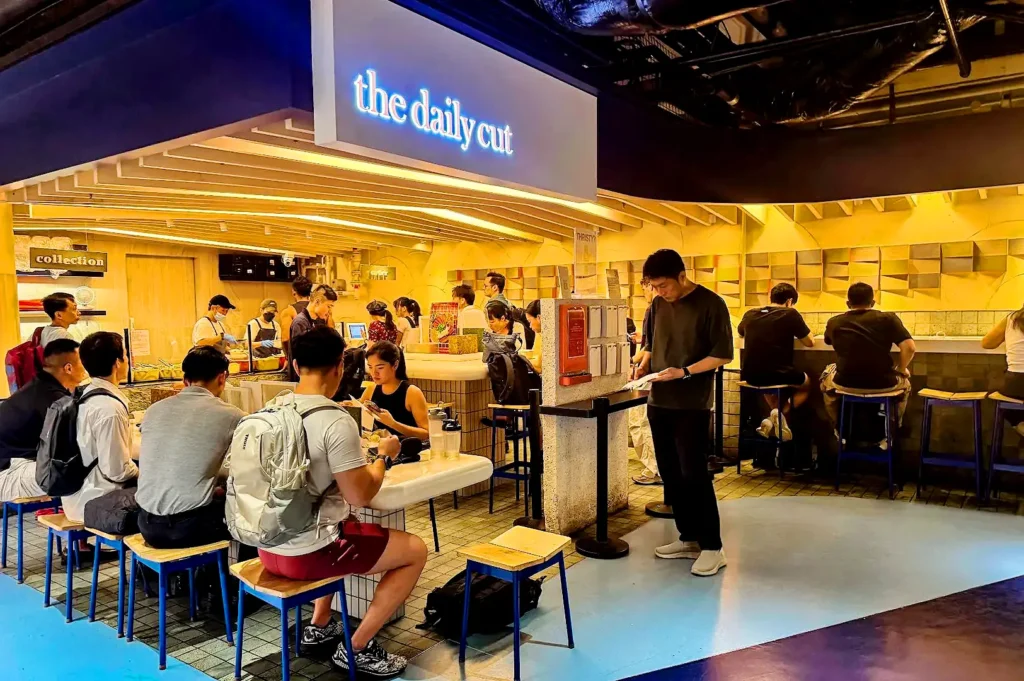
It’s 12:40pm, and the basement of One Raffles Place smells of rice, citrus, and the cold breath of air-conditioning.
The queue at The Daily Cut moves in short steps. Lanyards swing against shirts. A woman ahead of me stares at the glass counter as if it were an exam paper. Greens, grains, roasted pumpkin, sliced steak still faintly pink at the centre. She points, hesitates, and points again.
Behind the counter, gloved hands wait. They don’t rush her.
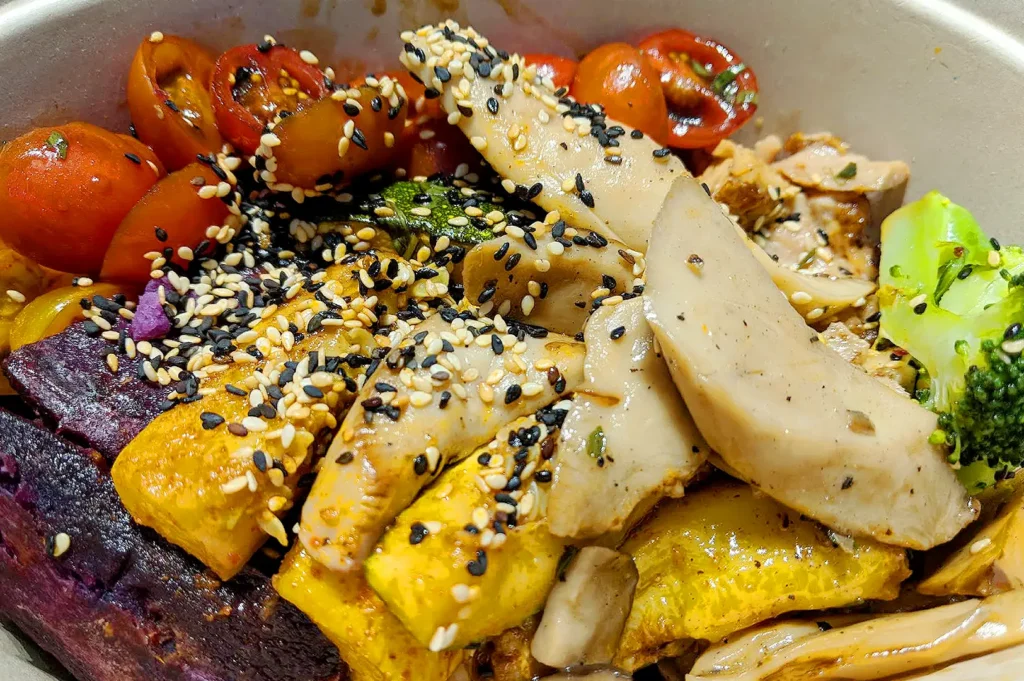
When it’s my turn, I watch the bowl come together. Brown rice goes down first, a sturdy floor for everything else. Then the teriyaki chicken, warm enough that I can see the steam lift. Charred broccoli and raw cabbage go on the side for crunch. An onsen egg slides on top, trembling. The green sauce comes last, spooned over at the very end so nothing turns soggy before I sit down.
There’s a logic to that order. Base, protein, crunch, richness, brightness. It looks like a salad bar, but it works more like a sentence. Each part has to lean on the one before it.
I find a seat and break the egg first. The yolk runs slow and golden into the rice. Cool cabbage against warm chicken. The sauce is sharp and herby, and it wakes up everything underneath it. For a moment I forget this is supposed to be the “good” lunch.
That word sits heavily in the CBD. Lunch here often carries a quiet moral weight. Char kway teow on Friday, a salad on Monday to make up for it. People eat at their desks, or in the forty minutes between calls. Healthy food becomes one more task to finish, something to endure rather than enjoy.
For more places built around the same compressed workday rhythm, our Raffles Place Food feature explores the restaurants that understand the CBD lunch rush.
I’ve eaten plenty of bowls like that. Limp leaves. Dry chicken. A sad spoonful of dressing in a plastic cup. They feel less like meals and more like penance.
What stays with me at The Daily Cut is that the bowl doesn’t ask me to suffer. It seems to understand what a hawker uncle knows without saying. A meal needs contrast. Something rich to hold onto. Something crisp to break the rhythm. Something bright to cut through at the end.
There’s still a tension here. This is fast food in its own way, built for a queue and a clock. The choices can pile up until deciding feels like work. And a menu of endless options can sometimes feel like freedom handed back to you as homework.
But inside that speed, someone has thought about texture. Someone decided the sauce goes last. The menu shifts with the seasons, so the counter never quite settles into habit. That kind of care is easy to miss when you’re eating with one eye on your phone.
I finish slowly anyway. The last grains of rice are stained yellow from the yolk. Around me, the room is already thinning. People are gathering their bags and heading back up to the towers.
It was only lunch. A bowl built in under two minutes.
Still, I leave feeling fed rather than corrected. That feels like enough.

How to Drink Sake: Your Guide to Enjoying Japanese Sake Wine
Eda Wong | December 5, 2025
As Japan’s national beverage, this traditional sake is present at celebrations, quiet dinners, and spiritual offerings, weaving itself into the very fabric of daily life and reflecting Japan’s deep-rooted cultural heritage. Yet, for many outside of Japan, it remains a delightful mystery. You might find yourself wondering, how do you drink sake properly to unlock…

What Is Sashimi? A Guide to Raw Fish, Sliced Raw Fish, and Japanese Seafood
Eat Drink Asia Team | December 3, 2025
Sashimi is one of the clearest ways to understand Japanese cuisine because there is very little to hide behind. At its simplest, sashimi is sliced raw fish or seafood served without sushi rice, usually with soy sauce, wasabi, and simple garnishes such as daikon radish. But the dish is not just “raw fish on a…

Understanding Sake Alcohol Content: A Complete Guide to ABV and Flavor
Eda Wong | December 2, 2025
When exploring Japanese sake, many wonder about its grades and complex flavors. Sake’s unique profile offers remarkable versatility, enjoyed in various serving styles and paired with diverse dishes. One fundamental aspect is sake alcohol content. Is sake stronger than wine? How does its alcohol by volume (ABV) compare to beer? The answer is nuanced. Understanding…
-
Japanese Sake: The Complete Guide to Japan’s Traditional Rice Wine
Dio Asahi | November 29, 2025
Japanese Sake: The Complete Guide to Japan’s Traditional Rice Wine While sake has been Japan’s national beverage for over a millennium, its popularity across Asia is at an all-time high. Rooted in Japan’s traditional brewing methods and centuries-old origins. It symbolizes Japan’s cultural heritage and craftsmanship. Understanding this complex brewed alcoholic beverage opens doors to…

Best Japanese Foods in Japan: The Must-Try Dishes
Eda Wong | November 27, 2025
Japan’s culinary world extends far beyond well-known sushi and ramen, revealing a rich variety of regional specialties cherished by locals. While many travelers stick to popular Japanese foods in tourist areas, authentic flavors are best discovered in neighborhood markets, family-run eateries, and seasonal menus reflecting centuries of Japanese cooking tradition. Understanding Japanese cuisine requires more…
-
Japanese Food in Japan: The Ultimate Guide to Authentic Culinary Experiences
Eat Drink Asia Team | November 25, 2025
Experiencing Japanese food in Japan is fundamentally different from eating Japanese cuisine anywhere else. While sushi restaurants and ramen shops have spread globally, the authentic flavors, techniques, and cultural context of Japanese food can only be fully appreciated in its homeland. From meticulously selecting ingredients at peak freshness to centuries-old traditions shaping every meal, eating…
-
Food in Japan: A Complete Guide to Japanese Cuisine and Culinary Culture
Eda Wong | November 22, 2025
The gentle steam rising from a bowl of miso soup carries more than just the earthy aroma of fermented soybeans-it carries centuries of Japanese culture and culinary wisdom. When you eat in Japan, you’re not simply consuming a meal; you’re participating in a ritual that connects you to the seasons, the land, and a philosophy…
-
Ramune Marble Soda: History and Cultural Meaning of Japan’s Iconic Marble Soda
Dio Asahi | November 20, 2025
Among Japan’s beloved fizzy drinks, none evoke nostalgia and uniqueness quite like Ramune marble soda. Instantly recognizable by its quirky Codd neck bottle and glass marble seal, Ramune soda is an essential part of Japanese summer, cherished by generations for its refreshing taste and signature pop sound. This marble soda remains a staple at summer…
-
Hokkaido’s Best Seafood Treasures: Beyond Sushi and Sashimi
Eat Drink Asia Team | November 18, 2025
When visiting Hokkaido, Japan’s northernmost island, food lovers are greeted with some of the most highly regarded seafood specialties in the world. Hokkaido is famous for its abundance of fresh seafood and rich fishing grounds, thanks to the surrounding Sea of Japan, Pacific Ocean, and Sea of Okhotsk. These nutrient-packed waters yield a wide range…
-
The Art of Asian Tea Ceremony Traditions: Ancient Rituals and Cultural Values Across Asia
Dio Asahi | November 15, 2025
A cup of tea, in many parts of Asia, represents far more than a beverage-it is a conduit to ancestral tradition, intellectual pursuit, and the cultivation of mindfulness. Asian tea ceremony traditions turn the act of drinking tea into a sophisticated art form, layered with symbolism, philosophy, and socio-cultural values. Each gesture, from scooping powdered…