There are cities you can understand through maps, and then there are cities like Kuala Lumpur that only begin to make sense when you follow what people eat. Not what is recommended or ranked, but what is repeated. The same stall visited every week, the same dish ordered without hesitation, the same flavours that feel familiar before they are even tasted.
Kuala Lumpur does not announce itself loudly through its cuisine, even though a lot of people like people (https://klfoodadventures.mystrikingly.com/) does. It unfolds slowly, often in spaces that seem ordinary at first glance. A coffee shop beneath aging apartments, a roadside stall that appears only in the evening, a corner shop where the queue forms before the shutters fully open. These are not destinations in the traditional sense, but they are where the city reveals itself most honestly.
We begin to notice that KL cuisine is not defined by a single identity, but by its layering. Malay, Chinese, and Indian influences sit side by side, not in separation but in quiet negotiation. A dish may carry techniques and flavours from multiple traditions without needing to explain itself. It simply exists, shaped by the rhythms of the people who make it.
This is where the idea of specialty becomes more complex. In Kuala Lumpur, a specialty is rarely about exclusivity or refinement. It is about repetition and consistency, about doing one thing well enough that it becomes part of someone’s routine. A hawker preparing the same dish for decades is not just serving food, but maintaining something others rely on.
And yet, these recipes are not fixed. What we call tradition here is constantly shifting, often in ways that are subtle and undocumented. Ingredients change with availability, techniques adapt depending on who takes over, and flavours evolve quietly over time. These differences are not written down, but they are felt by those who return often enough to notice.
This is what makes KL’s food culture both resilient and fragile. It adapts without losing its core, but much of it exists without formal preservation. Recipes are passed through practice rather than instruction, and when a stall closes, what disappears is not just a dish, but a way of making it. What remains is memory, and even that shifts over time.
We see this clearly in how dishes are experienced rather than defined. A plate might be known for its balance, its timing, or the consistency of its preparation, rather than a fixed set of ingredients. The smallest decisions, when to add heat, when to stop, how long to wait, shape the final outcome. These are not easily translated, but they matter.
In many ways, Kuala Lumpur resists simplification. It does not fit neatly into categories designed for easy understanding. It asks for attention, for repeated visits, and for a willingness to accept that what you experience today may not be exactly the same tomorrow. That variability is not a flaw, but part of its identity.
We return not just for the food, but for the familiarity of the process. The act of ordering, the rhythm of waiting, the recognition between vendor and customer. These small interactions form a structure that holds the city together in ways that are easy to overlook.
If we try to define Kuala Lumpur’s cuisine too quickly, we miss what makes it meaningful. The city is not built on singular highlights, but on accumulation**. Small, repeated experiences that gradually shape how we understand it.**
Because in Kuala Lumpur, food is not just something you seek out. It is something you grow into.

Tiong Shian Porridge Centre Review: The Soft Counterweight to Chinatown’s Crisp Toast
Dio Asahi | September 22, 2026
I’d spent the morning with kaya toast. Crisp bread, cold butter, the clean snap of it between my teeth. Good, all of it. But by the time I’d walked a few streets over to New Bridge Road, my mouth wanted the opposite. Something warm. Something that gave way instead of shattering. That’s how I ended…
-
Tong Ah Eating House Review: A Chinatown Breakfast That Still Begins with Kaya Toast
Eda Wong | September 19, 2026
I almost walked past it. I’d been looking for the old triangular building, the red-and-white one you see in every photo of Keong Saik, the one that made Tong Ah feel like a landmark before you’d even ordered anything. But that’s not where it lives anymore. It’s a few doors down now, at 35 Keong…
-
Breakfast at Chinatown Singapore: How Migration Built the City’s Morning Table
Eat Drink Asia Team | September 17, 2026
The first time I ate breakfast in Chinatown, I got it wrong. I arrived at eleven, hungry and hopeful, and found the kopi stalls already turning toward lunch. The porridge uncle was packing up. The toast man had switched to slicing char siew. I ate a rushed plate of noodles standing near a pillar, sweating,…
-
The Bitter Leaf Folded Into a Burmese Home Kitchen
Eda Wong | September 16, 2026
The oil is already hot when she reaches for the leaves. It’s late morning in a kitchen off a quiet lane, and a woman I’ve been watching stands over a blackened wok, tearing bitter gourd leaves by hand into a small heap. The garlic hits the oil first, sharp and loud. Then the leaves go…
-
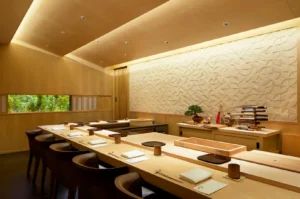
Best Sushi Singapore: From Premium Japanese Restaurants to Exclusive Deals from Affordable Sushi Trains
Dio Asahi | September 15, 2026
I’ve been eating sushi in this city for years now, from S$1.50 plates rolling past on a belt to omakase counters where the bill made me sit up straight. Somewhere along the way I stopped chasing “the best” and started noticing something else — that good sushi answers a mood, not a ranking. Some nights…
-
Al Mubin Restaurant and the Nasi Goreng Sambal Ayam That Has to Carry the Whole Plate
Eda Wong | September 12, 2026
It was close to eleven at night when I finally sat down. The kind of hour when you’re not really hungry so much as unsettled, when you want something warm in front of you more than you want a proper meal. Al Mubin’s food court at Block 407, Ang Mo Kio Avenue 10, was still…
-
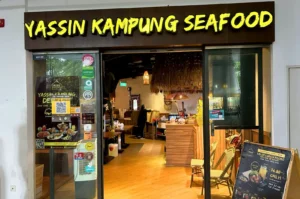
Yassin Kampung Admiralty Review: When Sambal Fried Rice Becomes the Whole Point
Eat Drink Asia Team | September 10, 2026
I ordered the sambal fried rice first, before I’d even properly read the menu. That’s usually a mistake at a place like this. Yassin Kampung @ Admiralty is the kind of restaurant that keeps trying to pull your attention elsewhere — toward stingray, toward crab, toward hotplates that arrive still hissing. But I’d come with…
-
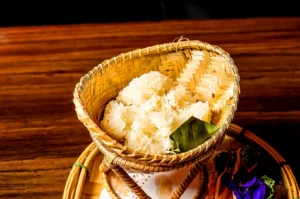
The Bamboo Basket Holding Chiang Mai’s Sticky Rice
Dio Asahi | September 9, 2026
By Dio Asahi for Eat Drink Asia. The lid comes off, and the steam rises first. It’s a warm afternoon in Chiang Mai, and on the table sits a small woven bamboo basket, still holding the heat of the pot it came from. Someone’s grandmother lifts the top and sets it aside without looking. Inside,…
-
Sambal Fried Rice Recipe for People Who Know the Chilli Paste Does the Heavy Lifting
Dio Asahi | September 8, 2026
I used to add the rice too early. The oil would be hot, the sambal barely a minute in, and I’d tip in the cold rice because I was hungry and impatient. Every time, the same result: rice stained red but tasting of nothing much. Sharp. Raw. Flat where it should have been deep. It…
-
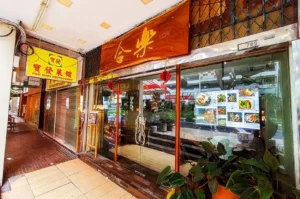
Hup Lok at Havelock Road: A Teochew Fish Soup Carrying Memory Forward
Eda Wong | September 8, 2026
The bowl arrives before anything else does. Steam lifts off it in slow ribbons, carrying the smell of ginger and something warmer underneath: the round, boozy note of hua tiao wine settling into fish. I lean in before I even pick up my spoon. The broth is pale gold and cloudy, thick enough that it…