By Dio Asahi for Eat Drink Asia.
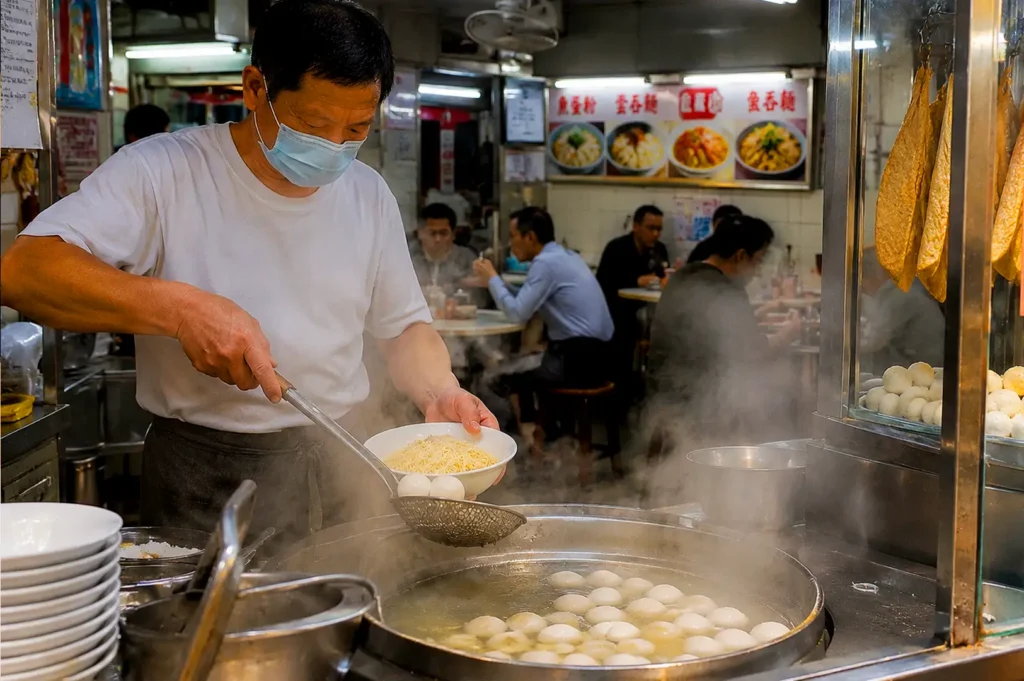
It’s a little past seven in the morning, and the stall is already breathing. Steam rolls off a deep metal pot near the front and fogs the glass where a row of fish cakes hangs on hooks. A ladle knocks against the rim. Somewhere behind me, a stool scrapes across the tiled floor.
The man at the pot doesn’t look up. He lifts a wire strainer, shakes it twice, and tips a handful of pale fish balls into a bowl of noodles. The broth follows, clear and faintly gold. The air smells of dried flatfish and white pepper, with something sweeter underneath, like the sea after rain.
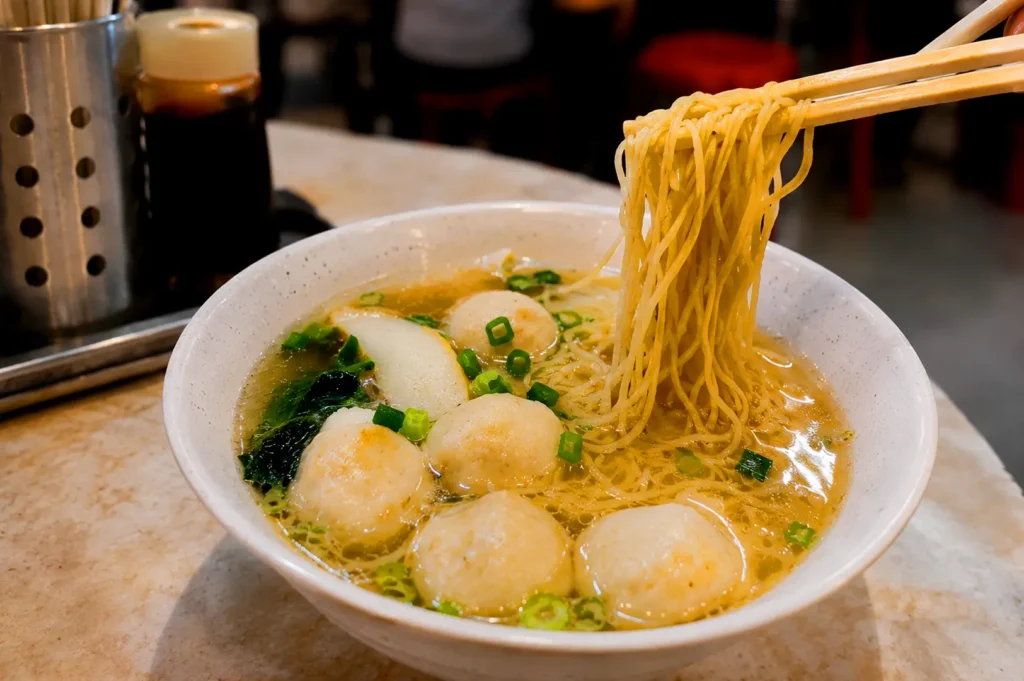
In Cantonese, they’re called yu daan (魚蛋), said roughly “yoo-dahn.” It means fish eggs. They aren’t eggs at all, just small rounds of fish paste, usually made from white-fleshed fish that’s been minced, salted, and worked until it turns glossy and tight.
The working is the whole thing. A good paste gets beaten and slapped against the side of a bowl, again and again, until it binds and starts to push back. Locals have a phrase for the result: daan ngaa, “bouncing teeth.” The fish ball should resist your bite for a second, then give.
At a noodle stall, they go into yu daan fan, fish balls with noodles. The noodles are often thin egg noodles or flat rice noodles, sitting in a broth simmered from fish bones and dried fish. Nothing hides here. There’s no thick sauce to cover a bad batch.
I’ve noticed nobody lingers. A woman in a security uniform orders standing up, then sits anyway when a stool frees up. A schoolboy eats with his backpack still on. When the room fills, strangers share tables without a word. People here call it daap toi, and the etiquette is simple: nod, sit, eat, leave room.
Ordering works like shorthand. A few syllables at the counter cover the noodle type, the toppings, and whether you want spring onion. The bowl lands before you’ve pulled your chopsticks from the tin box on the table.
That speed isn’t carelessness. It’s the city’s rhythm, folded into breakfast. A bowl like this is meant to fit between a train and a desk, warm enough to carry you through to lunch.
Eat Drink Asia is very keen at how quietly the cook manages the heat and that is something that stayed with us. The pot never quite reaches a rolling boil. If it runs too hot, the fish balls swell and toughen at the edges. He drops them in, waits until they rise and bob at the surface, then lifts them out moments later.
These days, plenty of stalls buy fish balls frozen. They come perfectly round, identical, and bright white. They’re convenient, and they fill a bowl. But the handmade ones here look a little uneven and slightly gray, with a fleck of fish skin now and then. They taste more of fish than of flour. That difference is easy to miss, and harder to keep.
I finish the broth last, tipping the bowl toward me the way the man beside me does. The steam has thinned. Outside, the street has filled with buses and footsteps.
Nobody photographs fish balls. They aren’t made for that. They’re made for an ordinary morning, a shared table, and a cook who still knows exactly when to lift the strainer.

Cuppage Plaza Food: Hidden Japanese Restaurants and Dining Gems Near Orchard
Dio Asahi | June 20, 2026
Orchard Road is a brilliant, trend-setting celebration of flavours, but its gleaming mega-malls can sometimes feel a bit predictable. If you are an urban food enthusiast seeking genuine culinary journeys rather than polished franchise menus, the true heart of the district lies slightly hidden. Cuppage Plaza is a fascinating, liminal space that operates almost like…
-
Makgeolli Bowls and the Soft Grain of Korean Rice Wine
Eda Wong | June 19, 2026
The monsoon rain drums a steady, heavy rhythm against the fogged windows of a narrow tavern in Jongno, muffling the chaotic pulse of the city outside. Inside, the air hangs warm, thick with the scent of toasted mung beans and a subtle, yeasty tang. A dented brass kettle tips forward, and a chalk-white, opaque liquid…

Kung Pao Chicken Sauce Is the Real Test: Why It Turns Glossy, Sharp, and Addictive
Eat Drink Asia Team | June 18, 2026
Kung pao chicken is often described by its main ingredients: diced chicken, dried chillies, peanuts, spring onions, and Sichuan peppercorns. But anyone who has cooked it at home knows the truth: the dish succeeds or fails because of the sauce. The sauce decides whether kung pao chicken tastes lively and balanced, or flat, sticky, and…
-
Jeju’s Seaweed Soup and the Memory of Birthday Tables
Dio Asahi | June 17, 2026
The sharp winter wind rattles the low stone walls of a Jeju Island kitchen, but inside, the air is thick with steam and the deeply marine scent of boiling kelp. An elderly woman stands by a bubbling steel pot, watching the dark green fronds swell and twist in the rolling water. She adds a splash…
-
Chicken Pao Recipe for People Who Respect Heat: Why Kung Pao Works Only When Timing Is Tight
Eda Wong | June 16, 2026
I remember my first attempt at cooking gong bao ji ding a few years ago. I wanted to recreate that authentic, trend-setting dish I had experienced at a traditional Sichuan restaurant, a meal that felt like a genuine celebration of flavours. I heated my wok until it was smoking, tossed in a handful of dried…
-
A Shu Yan Sichuan Cuisine Review Written in Pepper and Smoke: Chicken Pao That Wakes Up the Table
Dio Asahi | June 13, 2026
I used to think of authentic Sichuan food as a sheer test of endurance. For a long time, I assumed the goal was simply to survive the fiery onslaught of chillies rather than actually taste anything. But my recent culinary journey at Shu Yan Sichuan Cuisine completely rewired how I understand this region’s flavour map….
-
In Luang Prabang, Or Lam Carries the Taste of Sakhan
Eda Wong | June 12, 2026
The damp morning mist still clings to the teakwood houses of Luang Prabang as an elderly cook tends to a glowing charcoal brazier. Sparks jump lightly into the cool air, illuminating the blackened belly of an aluminium pot. Inside, a thick, dark liquid bubbles rhythmically, releasing an incredibly aromatic cloud of charred lemongrass, sweet Thai…
-
The Malayan Council, Reviewed: Local Food in Malaysia, Plated Like a Memory
Eat Drink Asia Team | June 11, 2026
Our Eat Drink Asia team spends a lot of time debating what makes a truly unforgettable meal. The team has previously published articles exploring the redefinition of comfort food. That is exactly what led me to The Malayan Council at 71 Bussorah Street. I visited on a Friday around 7:30 pm, just as the weekend…
-
Sushi in Singapore: Why There Is a Style for Every Budget
Eda Wong | June 11, 2026
Few Japanese dishes have travelled as successfully across Asia as sushi. What began as a culinary tradition deeply rooted in Japan has evolved into something remarkably diverse in Singapore. Today, sushi in Singapore can mean many different things. It can be a quick lunch grabbed from a conveyor belt restaurant, a carefully curated omakase meal…
-
The Quiet Pull of Lahpet in Myanmar’s Tea Leaf Salad
Dio Asahi | June 10, 2026
The afternoon humidity presses against the open-air teahouse in downtown Yangon, where the sharp clatter of a silver spoon against ceramic cuts through the low hum of conversation. A small plate sits in the centre of a low plastic table, holding a dense, dark green cluster that smells faintly of damp earth and sharp lime….