By Dio Asahi for Eat Drink Asia.
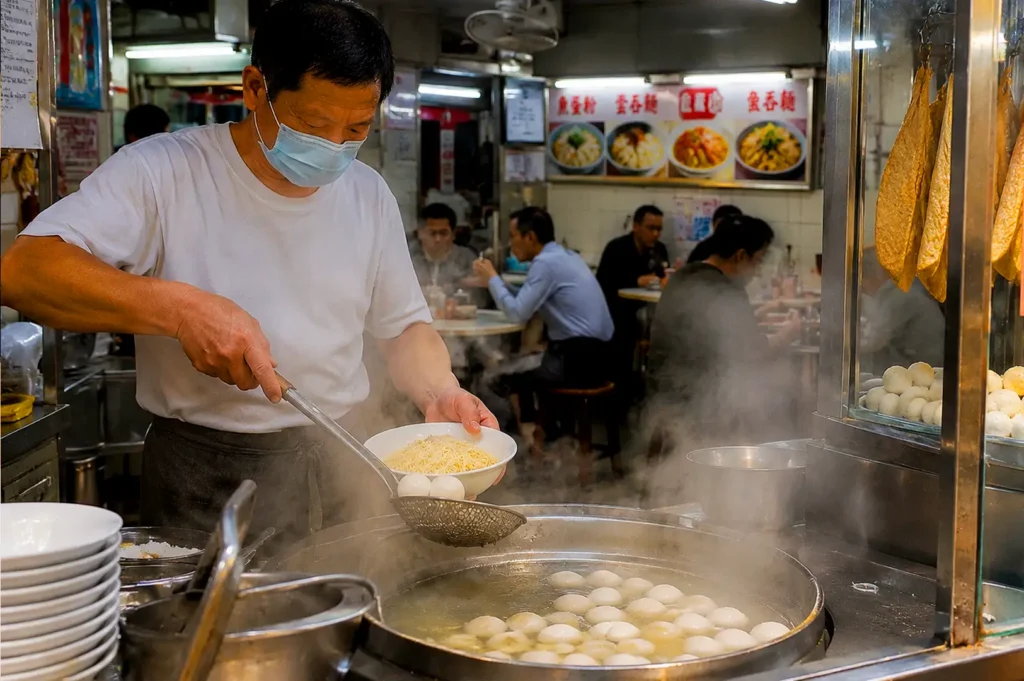
It’s a little past seven in the morning, and the stall is already breathing. Steam rolls off a deep metal pot near the front and fogs the glass where a row of fish cakes hangs on hooks. A ladle knocks against the rim. Somewhere behind me, a stool scrapes across the tiled floor.
The man at the pot doesn’t look up. He lifts a wire strainer, shakes it twice, and tips a handful of pale fish balls into a bowl of noodles. The broth follows, clear and faintly gold. The air smells of dried flatfish and white pepper, with something sweeter underneath, like the sea after rain.
In Cantonese, they’re called yu daan (魚蛋), said roughly “yoo-dahn.” It means fish eggs. They aren’t eggs at all, just small rounds of fish paste, usually made from white-fleshed fish that’s been minced, salted, and worked until it turns glossy and tight.
The working is the whole thing. A good paste gets beaten and slapped against the side of a bowl, again and again, until it binds and starts to push back. Locals have a phrase for the result: daan ngaa, “bouncing teeth.” The fish ball should resist your bite for a second, then give.
At a noodle stall, they go into yu daan fan, fish balls with noodles. The noodles are often thin egg noodles or flat rice noodles, sitting in a broth simmered from fish bones and dried fish. Nothing hides here. There’s no thick sauce to cover a bad batch.
I’ve noticed nobody lingers. A woman in a security uniform orders standing up, then sits anyway when a stool frees up. A schoolboy eats with his backpack still on. When the room fills, strangers share tables without a word. People here call it daap toi, and the etiquette is simple: nod, sit, eat, leave room.
Ordering works like shorthand. A few syllables at the counter cover the noodle type, the toppings, and whether you want spring onion. The bowl lands before you’ve pulled your chopsticks from the tin box on the table.
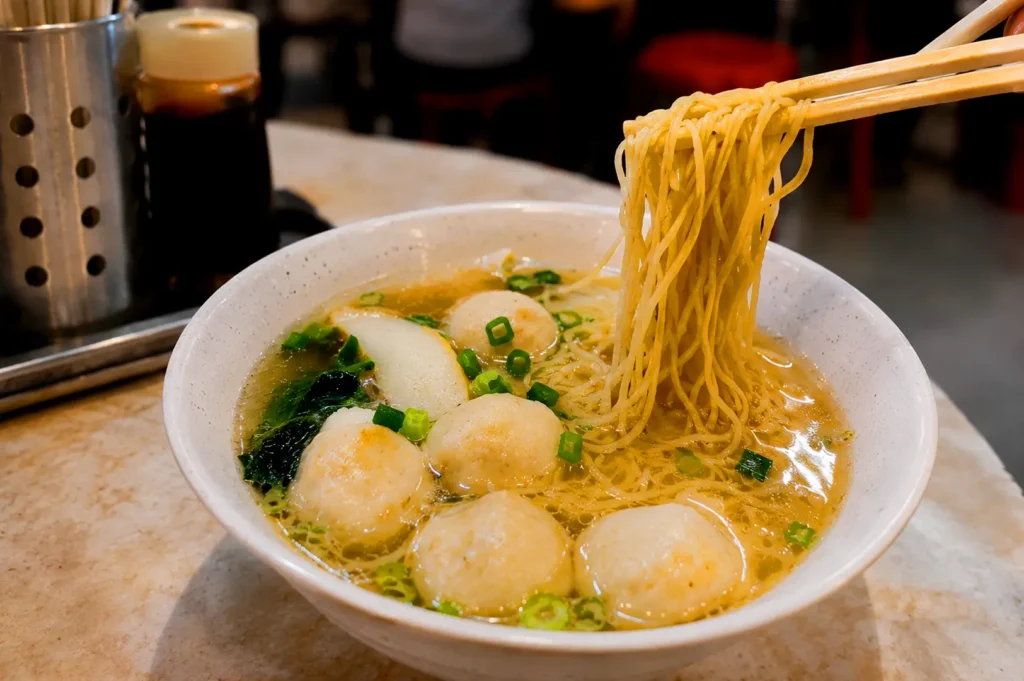
That speed isn’t carelessness. It’s the city’s rhythm, folded into breakfast. A bowl like this is meant to fit between a train and a desk, warm enough to carry you through to lunch.
Eat Drink Asia is very keen at how quietly the cook manages the heat and that is something that stayed with us. The pot never quite reaches a rolling boil. If it runs too hot, the fish balls swell and toughen at the edges. He drops them in, waits until they rise and bob at the surface, then lifts them out moments later.
These days, plenty of stalls buy fish balls frozen. They come perfectly round, identical, and bright white. They’re convenient, and they fill a bowl. But the handmade ones here look a little uneven and slightly gray, with a fleck of fish skin now and then. They taste more of fish than of flour. That difference is easy to miss, and harder to keep.
I finish the broth last, tipping the bowl toward me the way the man beside me does. The steam has thinned. Outside, the street has filled with buses and footsteps.
Nobody photographs fish balls. They aren’t made for that. They’re made for an ordinary morning, a shared table, and a cook who still knows exactly when to lift the strainer.

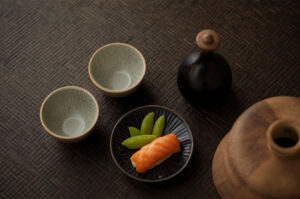
How to Drink Sake: Your Guide to Enjoying Japanese Sake Wine
Eda Wong | December 5, 2025
As Japan’s national beverage, this traditional sake is present at celebrations, quiet dinners, and spiritual offerings, weaving itself into the very fabric of daily life and reflecting Japan’s deep-rooted cultural heritage. Yet, for many outside of Japan, it remains a delightful mystery. You might find yourself wondering, how do you drink sake properly to unlock…

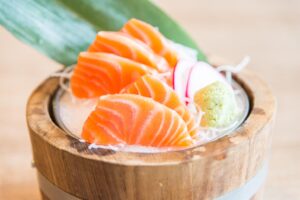
What Is Sashimi? A Guide to Raw Fish, Sliced Raw Fish, and Japanese Seafood
Eat Drink Asia Team | December 3, 2025
Sashimi is one of the clearest ways to understand Japanese cuisine because there is very little to hide behind. At its simplest, sashimi is sliced raw fish or seafood served without sushi rice, usually with soy sauce, wasabi, and simple garnishes such as daikon radish. But the dish is not just “raw fish on a…

Understanding Sake Alcohol Content: A Complete Guide to ABV and Flavor
Eda Wong | December 2, 2025
When exploring Japanese sake, many wonder about its grades and complex flavors. Sake’s unique profile offers remarkable versatility, enjoyed in various serving styles and paired with diverse dishes. One fundamental aspect is sake alcohol content. Is sake stronger than wine? How does its alcohol by volume (ABV) compare to beer? The answer is nuanced. Understanding…
-
Japanese Sake: The Complete Guide to Japan’s Traditional Rice Wine
Dio Asahi | November 29, 2025
Japanese Sake: The Complete Guide to Japan’s Traditional Rice Wine While sake has been Japan’s national beverage for over a millennium, its popularity across Asia is at an all-time high. Rooted in Japan’s traditional brewing methods and centuries-old origins. It symbolizes Japan’s cultural heritage and craftsmanship. Understanding this complex brewed alcoholic beverage opens doors to…

Best Japanese Foods in Japan: The Must-Try Dishes
Eda Wong | November 27, 2025
Japan’s culinary world extends far beyond well-known sushi and ramen, revealing a rich variety of regional specialties cherished by locals. While many travelers stick to popular Japanese foods in tourist areas, authentic flavors are best discovered in neighborhood markets, family-run eateries, and seasonal menus reflecting centuries of Japanese cooking tradition. Understanding Japanese cuisine requires more…
-
Japanese Food in Japan: The Ultimate Guide to Authentic Culinary Experiences
Eat Drink Asia Team | November 25, 2025
Experiencing Japanese food in Japan is fundamentally different from eating Japanese cuisine anywhere else. While sushi restaurants and ramen shops have spread globally, the authentic flavors, techniques, and cultural context of Japanese food can only be fully appreciated in its homeland. From meticulously selecting ingredients at peak freshness to centuries-old traditions shaping every meal, eating…
-
Food in Japan: A Complete Guide to Japanese Cuisine and Culinary Culture
Eda Wong | November 22, 2025
The gentle steam rising from a bowl of miso soup carries more than just the earthy aroma of fermented soybeans-it carries centuries of Japanese culture and culinary wisdom. When you eat in Japan, you’re not simply consuming a meal; you’re participating in a ritual that connects you to the seasons, the land, and a philosophy…
-
Ramune Marble Soda: History and Cultural Meaning of Japan’s Iconic Marble Soda
Dio Asahi | November 20, 2025
Among Japan’s beloved fizzy drinks, none evoke nostalgia and uniqueness quite like Ramune marble soda. Instantly recognizable by its quirky Codd neck bottle and glass marble seal, Ramune soda is an essential part of Japanese summer, cherished by generations for its refreshing taste and signature pop sound. This marble soda remains a staple at summer…
-
Hokkaido’s Best Seafood Treasures: Beyond Sushi and Sashimi
Eat Drink Asia Team | November 18, 2025
When visiting Hokkaido, Japan’s northernmost island, food lovers are greeted with some of the most highly regarded seafood specialties in the world. Hokkaido is famous for its abundance of fresh seafood and rich fishing grounds, thanks to the surrounding Sea of Japan, Pacific Ocean, and Sea of Okhotsk. These nutrient-packed waters yield a wide range…
-
The Art of Asian Tea Ceremony Traditions: Ancient Rituals and Cultural Values Across Asia
Dio Asahi | November 15, 2025
A cup of tea, in many parts of Asia, represents far more than a beverage-it is a conduit to ancestral tradition, intellectual pursuit, and the cultivation of mindfulness. Asian tea ceremony traditions turn the act of drinking tea into a sophisticated art form, layered with symbolism, philosophy, and socio-cultural values. Each gesture, from scooping powdered…