Steam lifts from a bowl of clear pork broth, and a spoonful of chopped pickled greens slides in. The broth shifts at once, its richness suddenly cut by a sharp, clean sourness that sits high and bright on the tongue. The greens have softened in the heat but keep a faint, springy crunch. Someone leans over the pot, breathes in, and adds another small handful, tasting after each one. The smell is unmistakable: tangy, slightly funky, alive in a way fresh vegetables never are. It is a small adjustment, almost invisible, and it changes everything in the bowl.
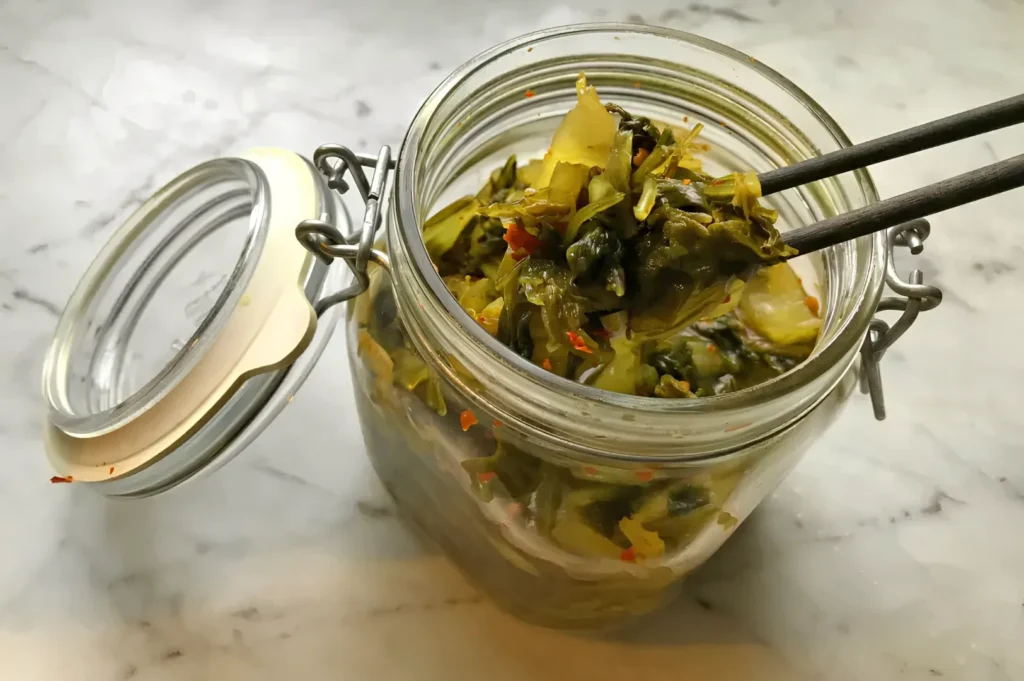
These are pickled mustard greens, known across regions as suancai (pronounced roughly swan-tsai), or as cải chua, or pak gard dong. The making is humble. Whole mustard greens are washed, salted, and pressed under a weight, then left to ferment in their own brine until the leaves turn translucent and deeply sour. Time does the work. A few days yields a gentle tang; longer brings a sharper, more pungent edge. Before they go into broth, the greens are usually rinsed and squeezed, a quiet act of calibration that decides how much sourness the cook wants. Too little rinsing and the soup turns aggressive; too much and the brightness disappears. In a clear broth, the greens do one thing perfectly: they lift fat, sharpen flavor, and keep the whole bowl from feeling heavy.
I learned this watching my grandmother tend her jar on the kitchen ledge, pressing the leaves down each evening with the flat of her hand. She never measured. She tasted the brine on a fingertip and knew. That jar was a household clock of sorts, a thing checked daily, replenished when it ran low, drawn from for noodle breakfasts and weekend soups. The greens were never the centerpiece. They were the note that made the rest make sense, the sour thread running through ordinary meals. It felt inseparable from an asian communal dining tradition—a shared table where one person’s careful jar quietly tuned everyone’s bowl. Whole families calibrated their cooking around one cook’s particular fermentation, a private standard passed hand to hand, rarely written down, often slightly different from the household next door.
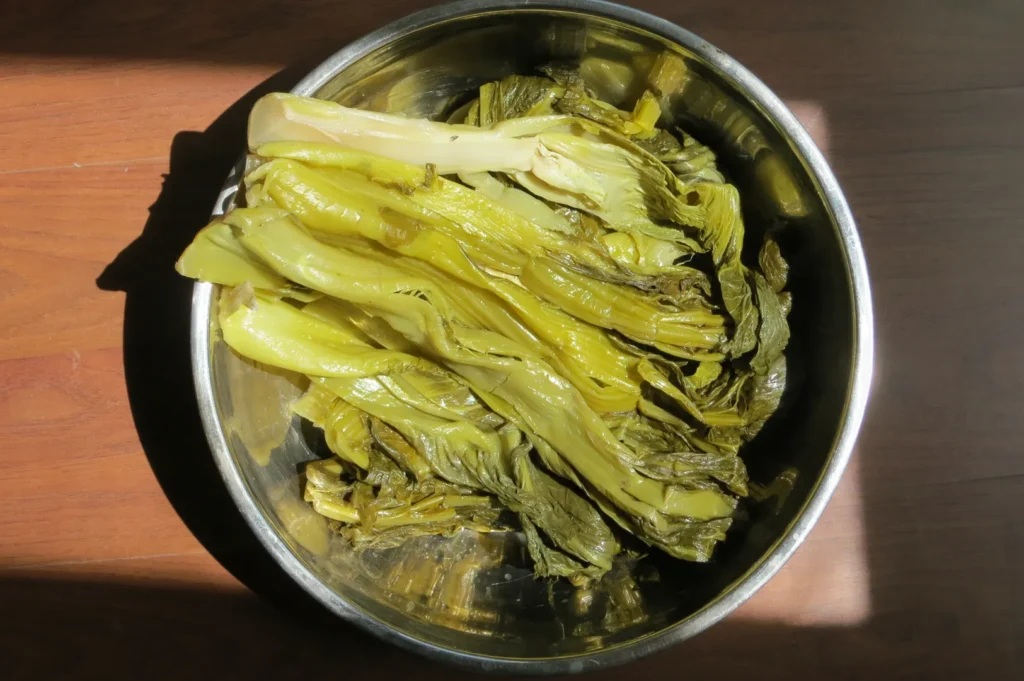
What stays with me now is how easily that calibration slips away. Factory-fermented greens fill the shelves, sealed in bright packets, consistent and convenient. They save the salting, the pressing, the daily tasting. But they arrive at a single fixed sourness, decided by a machine, not by a hand reading the brine. The skill of adjusting sour to suit a particular broth, a particular evening, a particular person’s tongue, fades when the jar disappears from the ledge. We gain ease. We lose the small, attentive judgment that made each bowl personal.
I think of that finger dipped in brine. It asked nothing of anyone, yet it carried a whole way of cooking—a quiet fluency in time and salt that a kitchen keeps alive only by tending it, day after day.

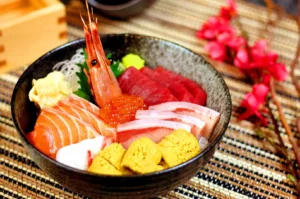
Chirashi Don Best Picks When Bowls Between the Sushi Counter and Lunch Are the Current Mood
Eat Drink Asia Team | August 18, 2026
There’s a specific kind of hunger that a chirashi don answers. It’s not the hunger for a full sushi omakase, with its slow ceremony and its quiet counter watching. And it’s not the hunger for something thrown together and forgotten by three o’clock. It sits somewhere in between — fish and rice in one bowl,…
-
Kopi Through the Cloth: Why the Strain Matters
Eda Wong | August 17, 2026
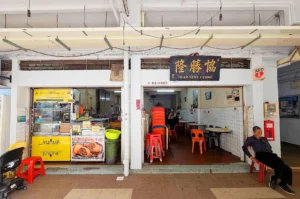
By Eda Wong for Eat Drink Asia. It is not yet seven, and the uncle at Heap Seng Leong has the pot going. He works the sock strainer over the tin cup with both hands, dipping and lifting, dipping and lifting, coaxing the coffee through the worn cloth. Steam rises between his fingers. The smell…
-
SBCD Korean Tofu House and the Comfort Logic of Bubbling Soondubu
Eda Wong | August 15, 2026
It was raining the afternoon I went. Not the polite kind, the sort that drums against the glass of Guoco Tower and makes you glad you’re already underground. I hadn’t planned on soondubu. I’d planned on something quick, something I could eat between the errands piling up in my head. But the rain does something…
-
The Knife Work at Hanashizuku Japanese Cuisine, Three Floors Above the Noise
Eda Wong | August 14, 2026
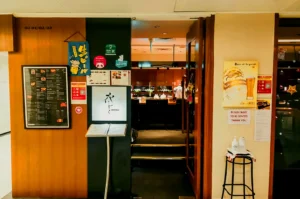
By Eda Wong for Eat Drink Asia. The lift doors open on a floor of Cuppage Plaza that has seen better decades. Peeling signage. A corridor that smells faintly of old carpet and cigarette smoke drifting from somewhere. Then a door slides shut behind me, and the noise falls away. Inside Hanashizuku Japanese Cuisine, the…
-
Todamgol Restaurant and the Comfort Logic Behind Famous Korean Foods
Dio Asahi | August 13, 2026
It was close to nine on a Friday when I finally found the door. Tanjong Pagar was doing its usual thing, full tables spilling onto five-foot ways, soju bottles catching the light, someone laughing too loudly two doors down. I almost walked past Todamgol. Then the smell reached me. Fermented, smoky, a little sharp. The…
-
The Same Grill, Three Decades On, at Kazu Sumiyaki Restaurant
Dio Asahi | August 12, 2026
By Dio Asahi for Eat Drink Asia. The lift opens on the fourth floor of Cuppage Plaza and the smoke finds me before the door does. Charcoal, dark and earthy, threaded through with something richer — fat meeting fire. I follow it down a narrow corridor, past shuttered shops and flickering signage, until I reach…
-
Popular Korean Cuisine Has a Memory: Why Famous Korean Food Feels So Complete
Eat Drink Asia Team | August 11, 2026
The first time I ordered kimchi jjigae in Singapore, I made a small mistake. It came bubbling in a stone pot, and I ate it like soup, spoonful after spoonful, straight down, until my mouth was on fire and the bowl was half gone. The auntie across the counter watched me for a moment, then…
-
Raffles Place Food Has the Restaurants That Understand the CBD Lunch Rush
Eda Wong | August 8, 2026
I used to think lunch in the CBD was a lost cause. You get an hour, maybe less. The lift takes ten minutes just to reach the ground floor. By the time you’ve queued, ordered, and found a corner to eat in, you’re already checking the clock. For a while, I gave up and just…
-
The Tamarind Sourness Inside a Filipino Sinigang Pot
Eda Wong | August 7, 2026
By Eda Wong for Eat Drink Asia. The pot has been going for a while now, and the whole kitchen knows it. Steam curls up from the surface, carrying that sharp-sour smell that reaches you before anything else. It’s not a gentle aroma. It pricks at the back of your throat a little, makes your…
-
Vegetarian Asian Dishes at The Boneless Kitchen: A Korean Meal Built on Kimchi, Rice, and Restraint
Dio Asahi | August 6, 2026
I didn’t expect to find Korean comfort food in an office building near Tai Seng. But there I was, on a Wednesday a little past 7pm, standing outside The Commerze @ Irving wondering if I’d read the address wrong. This isn’t the part of Singapore you go to for dinner. It’s the part you leave…