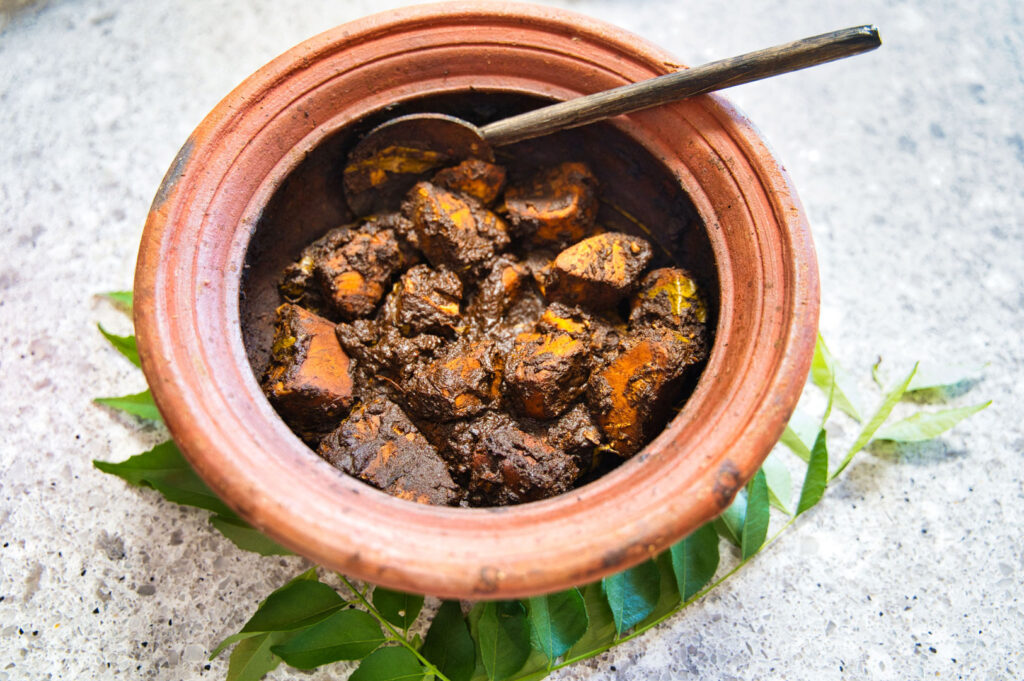
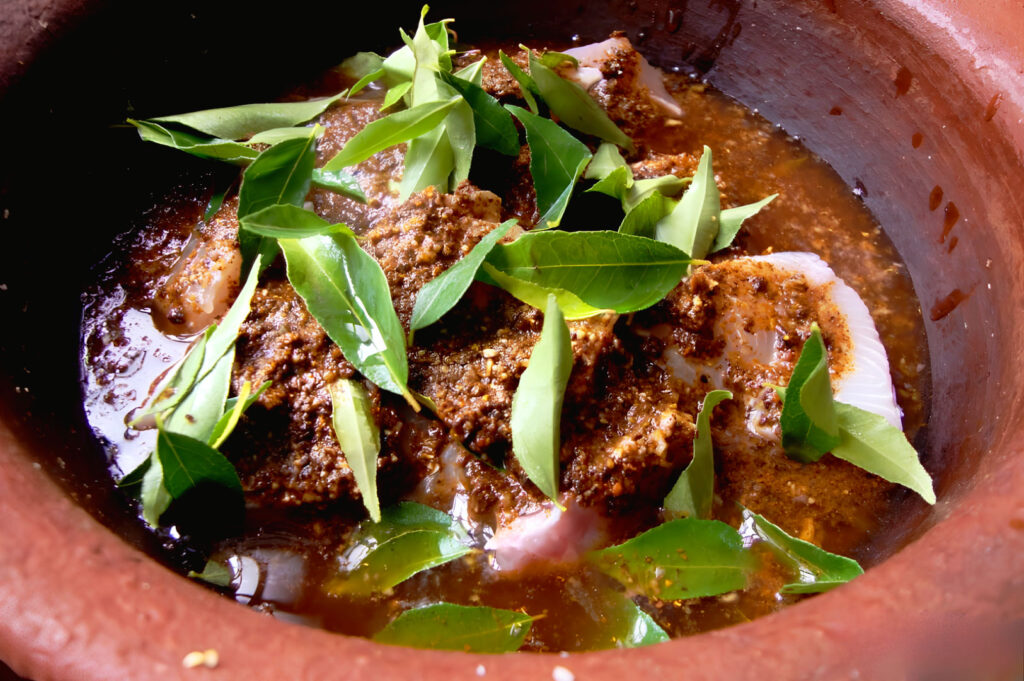
In the open-air kitchen of a coastal home in southern Sri Lanka, a low fire crackles under a wide, unglazed clay pot. The air is thick with the scent of roasted black pepper and something deeply, aggressively tart. A wooden spoon scrapes the bottom of the pot, turning cubes of firm yellowfin tuna until they are entirely coated in a thick, charcoal-colored paste. The heat is steady, slowly drawing the moisture from the fish, replacing it with a dense crust of spice. There is no rush here; the fire dictates the rhythm.
This is Ambul Thiyal, pronounced um-bool tee-yal, a foundational dish of Sri Lankan coastal cooking. Translated simply as “sour fish curry,” the name drastically undersells its complexity. The dish relies entirely on goraka, a sun-dried, deeply wrinkled fruit that imparts an intense, smoky sourness and a stark black hue to the sauce. To prepare it, cooks grind the goraka into a thick paste with roasted curry powder, black pepper, and cinnamon, vigorously massaging it into the tuna. As it cooks in the clay pot, the liquid evaporates, leaving the tuna dry, firm, and heavily crusted. The resulting texture is almost meaty, breaking apart in dense, intensely flavored flakes that vibrate with a sharp, earthy acidity.
In Sri Lanka, Ambul Thiyal is far more than a culinary preference; it is a masterclass in tropical ingenuity. Before refrigeration, coastal communities needed a method of tuna preservation that could withstand the island’s punishing humidity. The extreme acidity of the goraka, combined with the dry-cooking technique, naturally cures the fish, allowing it to sit safely at room temperature for days. Today, even with modern conveniences, the ritual remains unbroken. You will find it packed into tiffin boxes for long train journeys, served alongside milk rice during the Sinhalese New Year, or sitting quietly on a Tuesday lunch table. It signals a deep, pragmatic relationship with the ocean and the surrounding spice gardens.
In a global food culture that often prizes delicate, lightly seared seafood, Ambul Thiyal stands out for its absolute refusal to be mild. It is a dish of deliberate, concentrated intensity. It demands time and requires an intuitive understanding of how acid and spice can entirely transform a protein. Recognizing this method feels vital right now, as modern convenience increasingly strips our diets of such bold, time-honored preservation techniques. It is a reminder that some of the most profound flavors are born out of necessity, requiring nothing more than a clay pot, the right fruit, and patience.
The fire eventually burns down to white ash, and the clay pot is lifted from the hearth. Inside, the blackened tuna rests, completely transformed by the goraka and the heat. For cooks who love long-braised curry recipes, this dry-cooked preservation method offers a striking counterpoint, proof that depth can come from reduction as much as from simmering. It is a quiet testament to a coastal craft that endures, piece by spiced piece.

The Coconut Spoon That Shapes Nyonya Kueh Salat
Eda Wong | August 21, 2026
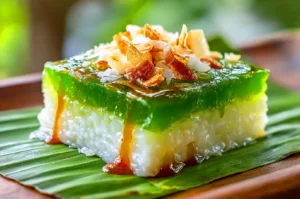
By Eda Wong for Eat Drink Asia. Steam curls up from a tray in the back of the kitchen, and the whole room smells green. Pandan, crushed and knotted, pushed through wet cloth until the leaves give up their colour. An auntie leans over the tray with a spoon carved from coconut shell, dark and…
-
Chicken Nasi Goreng Recipe: What Leftover Rice Becomes After the Wok Gets Serious
Dio Asahi | August 20, 2026
There’s a container of rice at the back of my fridge most weeks. Cold, a little hard, forgotten from a dinner two nights ago. Some people see that and think of waste. I see the start of something better. Because leftover rice doesn’t want to be reheated. It wants to be fried. And when it…
-
The First Ladle of Miso Soup in a Tokyo Breakfast Shop
Dio Asahi | August 19, 2026
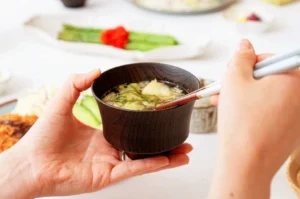
By Dio Asahi for Eat Drink Asia. The shop is barely wider than a hallway. Seven stools, a counter worn smooth, and behind it a woman ladling soup into small ceramic bowls before anyone has ordered it. Steam lifts off the surface and fogs the window against the cold morning. The bowl reaches me warm…
-
Chirashi Don Best Picks When Bowls Between the Sushi Counter and Lunch Are the Current Mood
Eat Drink Asia Team | August 18, 2026
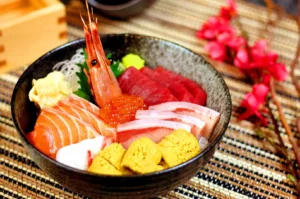
There’s a specific kind of hunger that a chirashi don answers. It’s not the hunger for a full sushi omakase, with its slow ceremony and its quiet counter watching. And it’s not the hunger for something thrown together and forgotten by three o’clock. It sits somewhere in between, fish and rice in one bowl, cool…
-
Kopi Through the Cloth: Why the Strain Matters
Eda Wong | August 17, 2026
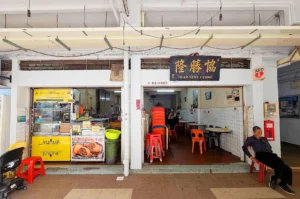
By Eda Wong for Eat Drink Asia. It is not yet seven, and the uncle at Heap Seng Leong has the pot going. He works the sock strainer over the tin cup with both hands, dipping and lifting, dipping and lifting, coaxing the coffee through the worn cloth. Steam rises between his fingers. The smell…
-
SBCD Korean Tofu House and the Comfort Logic of Bubbling Soondubu
Eda Wong | August 15, 2026
It was raining the afternoon I went. Not the polite kind, the sort that drums against the glass of Guoco Tower and makes you glad you’re already underground. I hadn’t planned on soondubu. I’d planned on something quick, something I could eat between the errands piling up in my head. But the rain does something…
-
The Knife Work at Hanashizuku Japanese Cuisine, Three Floors Above the Noise
Eda Wong | August 14, 2026
By Eda Wong for Eat Drink Asia. The lift doors open on a floor of Cuppage Plaza that has seen better decades. Peeling signage. A corridor that smells faintly of old carpet and cigarette smoke drifting from somewhere. Then a door slides shut behind me, and the noise falls away. Inside Hanashizuku Japanese Cuisine, the…
-
Todamgol Restaurant and the Comfort Logic Behind Famous Korean Foods
Dio Asahi | August 13, 2026
It was close to nine on a Friday when I finally found the door. Tanjong Pagar was doing its usual thing, full tables spilling onto five-foot ways, soju bottles catching the light, someone laughing too loudly two doors down. I almost walked past Todamgol. Then the smell reached me. Fermented, smoky, a little sharp. The…
-
The Same Grill, Three Decades On, at Kazu Sumiyaki Restaurant
Dio Asahi | August 12, 2026
By Dio Asahi for Eat Drink Asia. The lift opens on the fourth floor of Cuppage Plaza and the smoke finds me before the door does. Charcoal, dark and earthy, threaded through with something richer — fat meeting fire. I follow it down a narrow corridor, past shuttered shops and flickering signage, until I reach…
-
Popular Korean Cuisine Has a Memory: Why Famous Korean Food Feels So Complete
Eat Drink Asia Team | August 11, 2026
The first time I ordered kimchi jjigae in Singapore, I made a small mistake. It came bubbling in a stone pot, and I ate it like soup, spoonful after spoonful, straight down, until my mouth was on fire and the bowl was half gone. The auntie across the counter watched me for a moment, then…