By Dio Asahi for Eat Drink Asia.
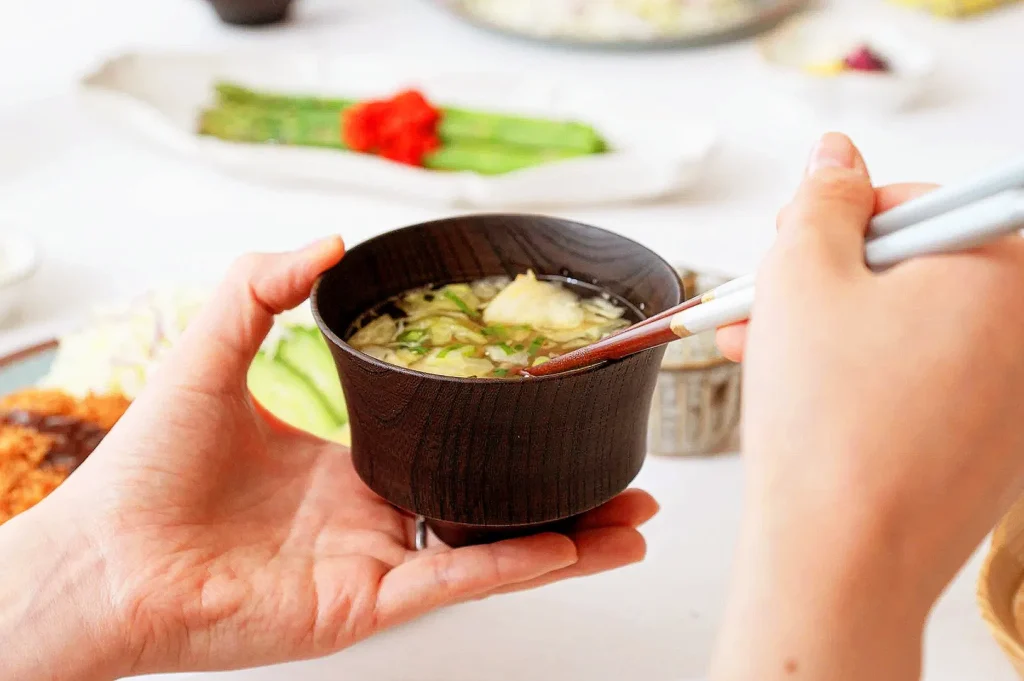
The shop is barely wider than a hallway. Seven stools, a counter worn smooth, and behind it a woman ladling soup into small ceramic bowls before anyone has ordered it. Steam lifts off the surface and fogs the window against the cold morning. The bowl reaches me warm in both hands, heavier than it looks. There’s a smell first — something salted, deep, almost like the sea remembered rather than tasted. Then the sip. Cloudy, gentle, faintly sweet under the salt. Outside, a train sighs into the station. Inside, nobody speaks yet.
What I’m holding is miso soup — 味噌汁, roughly “mee-so shiru.” At its simplest, it’s fermented soybean paste dissolved into dashi, a stock usually drawn from kombu seaweed and dried bonito flakes. That’s the whole architecture. The miso brings the salt and the funk, that living, fermented depth. The dashi brings the quieter thing underneath — a savoury base the Japanese call umami, which is less a flavour you name than one you feel settle in the back of the throat.
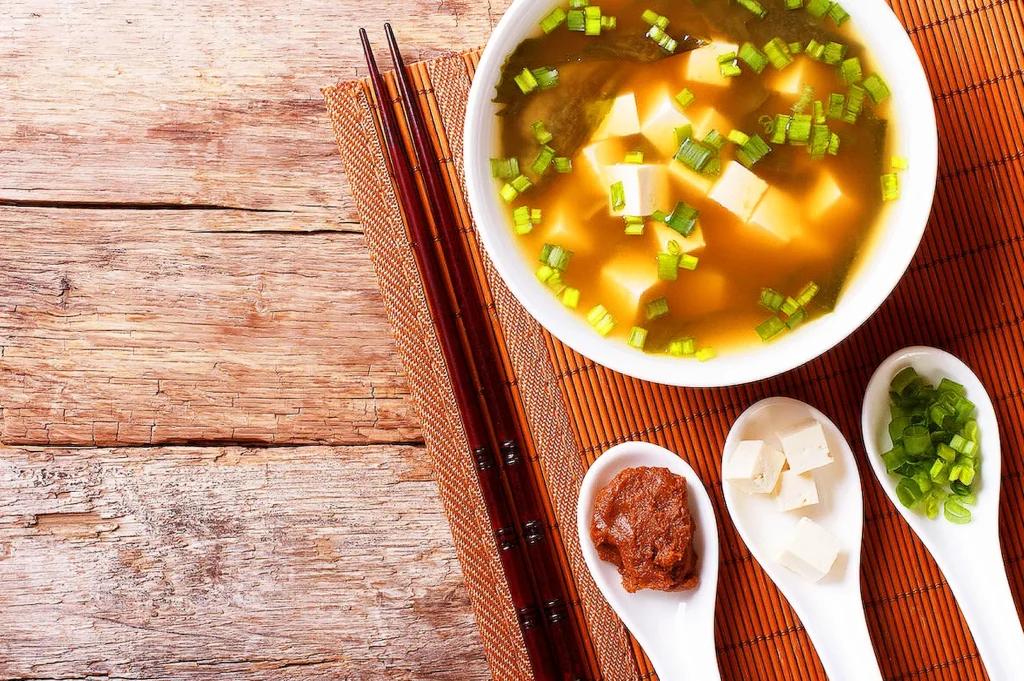
There’s often a little inside the broth. Cubes of soft tofu, a few slippery strands of wakame, sometimes sliced green onion floating on top. But the soup isn’t really about what’s in it. It’s about the liquid itself, and the way it arrives hot and unhurried, at the start of the day, without ceremony.
Watch a Tokyo breakfast shop at seven in the morning and you notice the rhythm before you notice the food. People arrive alone, mostly. They sit, they receive the bowl, they eat with a kind of practiced quiet. The soup is rarely the main dish — it comes beside rice, grilled fish, a raw egg. But it’s the first thing lifted, the first warmth of the morning. There’s an etiquette to it, too: you drink from the bowl, tilting it, rather than spooning. It signals something small and communal. Everyone here is doing the same thing at the same hour, in the same silence, before the city asks anything of them.
The craft hides in the timing. Dashi is warmed, but the miso is stirred in only at the end, off the strongest heat — never boiled. Boil it, and the miso turns flat and sour, the living quality cooked out of it. The woman behind the counter dissolves it through a small strainer with the back of a ladle, so no lumps remain, seconds before serving.
You can buy miso in a packet now. Tear, pour, add hot water, done. It’s not bad, and I understand why a tired morning reaches for it. But the packet version is a copy of a gesture, not the gesture itself, it is not what Eat Drink Asia stands for. The handmade bowl carries the memory of someone deciding not to let it boil — a small, deliberate act of care, repeated at dawn, for strangers.
I finished the bowl before I’d finished thinking about it. The woman was already ladling the next.
Some mornings ask for nothing more than that. Warmth, handed over. A quiet way of being fed.

Padang Beef Rendang: The Complex Process Behind Indonesia’s Most Famous Dish
Eda Wong | October 30, 2025
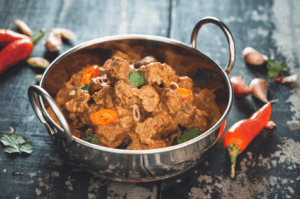
This post may contain affiliate links. For full transparency, this article may contain affiliate links. To call Padang beef rendang simply a dish is to miss the soul of Indonesian cuisine. This legendary slow-cooked dry curry, a centerpiece of both festive tables and humble meals, has earned its fame as one of the world’s most…
-
Teh Tarik Malaysia: The Art and Science Behind Iconic Pulled Tea
Eat Drink Asia Team | October 28, 2025
In Malaysia, ordering a cup of teh tarik is about so much more than just enjoying a hot drink. Teh tarik, literally translated as “pulled tea,” is Malaysia’s national beverage, famous for its sweet, creamy taste, frothy top, and the spectacular pulling technique seen in bustling mamak stalls and coffee shops across the country. A…
-
The Legendary Penang Char Kway Teow: A Culinary Journey
Dio Asahi | October 25, 2025
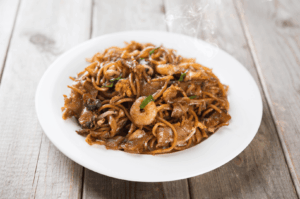
The air in Penang is thick with anticipation, carrying the sounds and smells of Malaysian street food being crafted with expert care. Your attention is captured by one of the many street vendors, a master standing before a seasoned wok glowing over an intense fire. The rhythmic clanging of metal on metal is the soundtrack…
-
Traditional Korean Sikhye: Sweet Rice Punch Through the Seasons
Eda Wong | October 23, 2025
In the vibrant world of Korean food, beyond the fiery spice of gochujang and the savoury comfort of bulgogi, lies a gentler, more subtle delight. Meet traditional Korean sikhye (식혜), a beloved Korean sweet rice punch that holds a special place in the nation’s heart. With its cloudy, amber hue and delicate sweetness, this drink…
-
Authentic Jeonju Bibimbap: Why Korea’s Culinary Capital Makes It Best
Eat Drink Asia Team | October 21, 2025
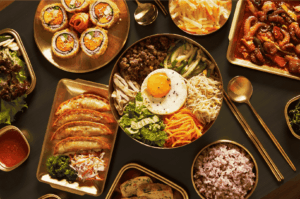
Picture this: A steaming Korean rice bowl is placed before you in Jeonju, South Korea. Vibrant arcs of seasoned bean sprouts, glossy strips of Korean beef, a golden runny yolk resting atop perfectly cooked mixed rice, and a dollop of rich red bibimbap sauce invite you to mix it all together. As you stir, the…
-
Communal Dining Traditions in Asia: Shared Meals, Lasting Bonds, and Cultural Heritage
Dio Asahi | October 18, 2025
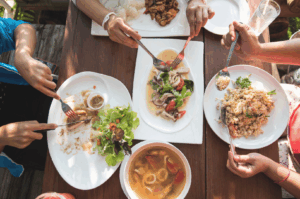
Imagine a dining table crowded with large platters of steaming food, the smell of spices in the air, small bowls arranged neatly around the shared table, and laughter echoing across the room. Across Asia, dining tables play a central role in communal dining traditions, serving as the focal point for etiquette, social interaction, and the…
-
Century-Old Dumpling Techniques: Ancient Wisdom in Modern Kitchens
Eda Wong | October 16, 2025
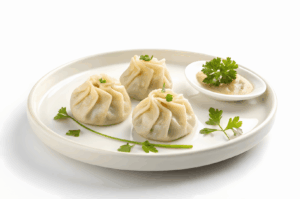
Her hands move in a blur, a dance of muscle memory refined over sixty years. In a small, steam-filled kitchen in Shanghai, an elderly woman transforms a humble circle of dumpling dough into a perfect, 20-pleat xiao long bao. Each pinch and fold is a syllable in a story passed down through generations-prime examples of…
-
Ca Phe Sua Da: The Cultural Phenomenon of Authentic Vietnamese Coffee
Eat Drink Asia Team | October 14, 2025
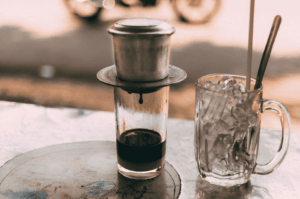
The dawn breaks over Hanoi, and the city awakens not to alarm clocks but to the clatter of tiny spoons and the metallic click of filters. The air fills with the dark, roasted aroma of authentic Vietnamese coffee drifting from bustling corners and sidewalk stalls. They are not rushing. Instead, they are waiting-waiting for the…
-
Cao Lầu Noodles: Hoi An’s Legendary Noodle Dish with Japanese Origins
Dio Asahi | October 11, 2025
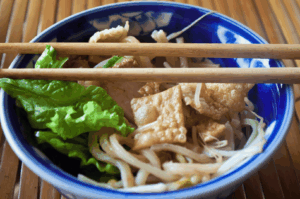
Imagine sitting on a low stool in a bustling alleyway of Hoi An’s ancient town. The warm, fragrant air is thick with the scent of sizzling marinated pork, fresh herbs, and the unmistakable aroma of fish sauce and fried rice crackers. In front of you, a bowl of Cao Lau noodles gleams, their golden brown…
-
Chinese Tea: 5,000-Year Tea Journey from Ancient Medicine to Global Beverage Phenomenon
Eda Wong | October 9, 2025
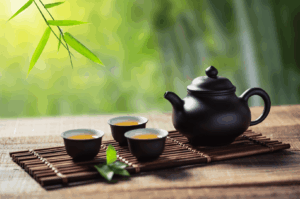
Every cup of tea enjoyed today, whether a brisk English breakfast or a delicate green tea in Tokyo, finds its lineage rooted in the heart of Chinese tea history. For nearly 5,000 years, the humble leaves of the Camellia sinensis tea plant have been cultivated, brewed, and cherished-first as ancient medicine in southern China, and…