By Dio Asahi for Eat Drink Asia.
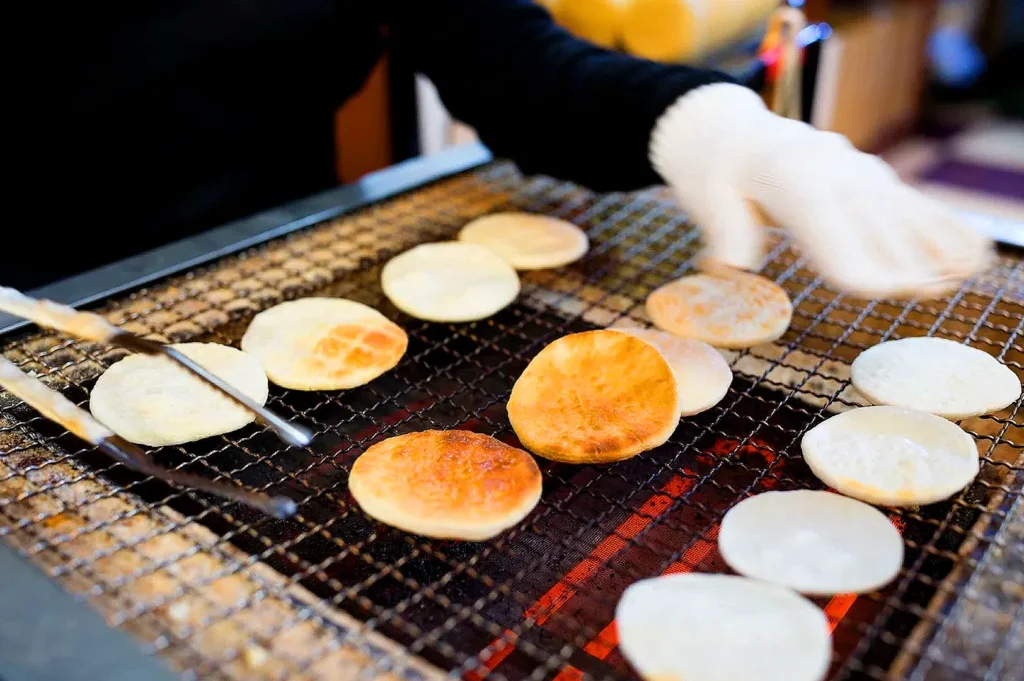
The old man works close to the coals, and the smell reaches me before I see what he’s doing. Soy meeting heat. That dark, caramel-edged smell that tightens something in your chest. His brush moves in short strokes across a rack of rice crackers, back and forth, patient. The coals tick. A cracker shifts on the grill with a small, dry sound. He doesn’t look up. In this narrow Kyoto shopfront, off the main street where the crowds thin out, there is only the fire, the brush, and the slow turn of each disc against the grate.
What he’s making is senbei — sen-bay — the soy-glazed rice cracker that most people now know only from plastic packets. The kind here begins with pressed rice, dried until it’s hard as a coin, then set over charcoal. As it heats, the cracker swells and blisters. That’s when the brush comes in. A soy-based glaze, wiped on in thin layers, not poured. Too much at once and it steams and turns bitter. Applied lightly, in the right window, the sugars in the soy catch the heat and set into a lacquered, savoury skin. He glazes, turns, glazes again. Each pass builds the colour. The timing is everything, and he keeps it in his hands, not on a clock.
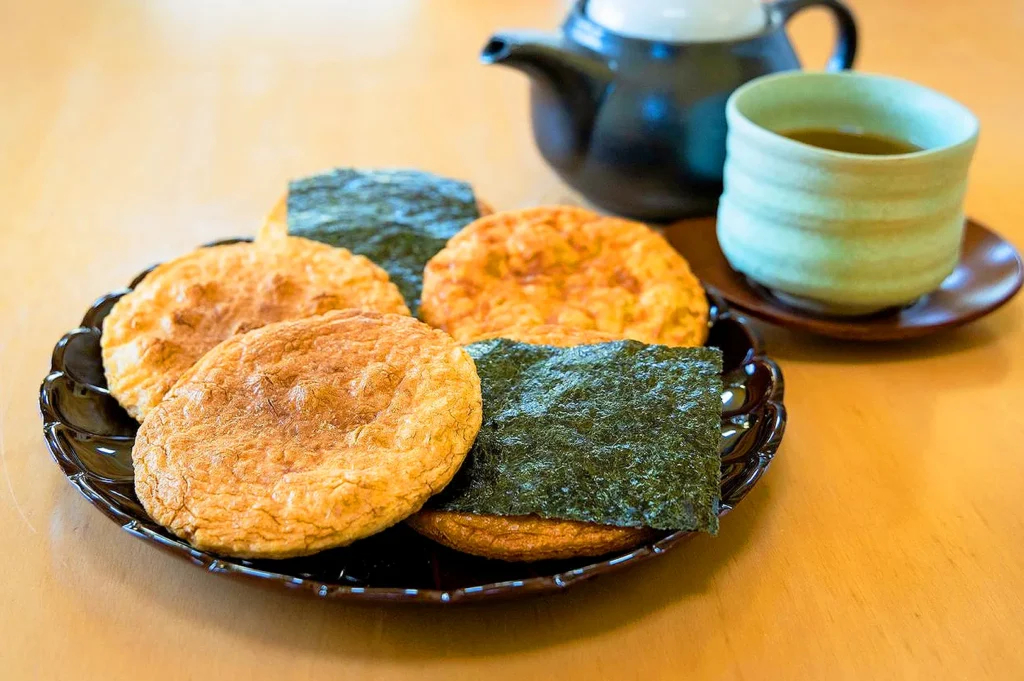
These crackers used to sit in shallow tins on every counter — beside the register, near the tea, offered to a guest before anyone asked. Senbei was the snack you handed to a neighbour, wrapped for a visit, kept for the child who came home from school. Not special-occasion food. Just the food that was always there. In some homes the good ones, the hand-grilled ones, were saved for guests, a small courtesy that said you matter enough for the ones that took time. You can still find that gesture, if you know the quiet shops. Most of us reach for the packet now instead.
The Eat Drink Asia highlight is how ordinary this is, and how easily it slips away. A machine can press and season a thousand crackers before this man finishes a single rack. The packet version isn’t bad. It’s just even — the same colour, the same crunch, edge to edge. His are uneven. One a shade darker where the glaze pooled, another lighter, blistered differently. That unevenness is the tell. It means a hand was there, deciding, in the moment the soy met the fire.
I take one still warm. It cracks loud between my teeth, and the soy is deep, faintly smoky, almost bitter at the edge where the glaze caught hardest.
He nods, once. Goes back to the brush.

Best Thai Singapore: Discover the Art of Authentic Pad Thai
Dio Asahi | December 11, 2025
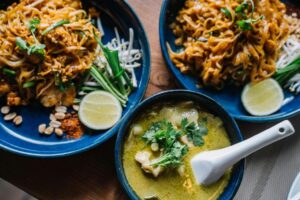
In Singapore, a city that celebrates a universe of flavors, the magnetic pull of Thai cuisine is undeniable. From bustling food courts to elegant dining rooms, the kingdom’s culinary ambassadors have firmly planted their flag. When considering the best Thai food, it’s impossible to overlook how integral Pad Thai is to the local Thai food…

Thai Cuisine in Singapore: Finding the Best Authentic Flavors
Eat Drink Asia Team | December 9, 2025
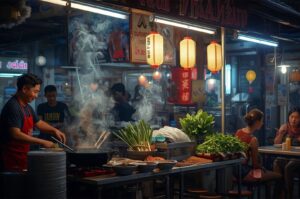
The unmistakable aroma of lemongrass, galangal, and fiery spices mingles with the bustling night air in Singapore, setting the stage for a dining experience that wakes the soul and tantalizes the senses. Thai cuisine in Singapore has become an essential part of the city’s culinary landscape, offering a complete blend of vibrant flavor, tangy notes,…
-
The Ultimate Guide to Thai Food: Flavors, Traditions, and Culinary Adventures
Dio Asahi | December 6, 2025
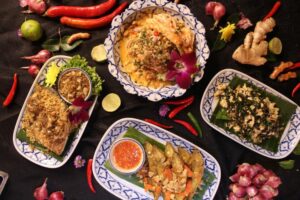
Thai cuisine is one of the world’s most beloved and complex culinary traditions, captivating food enthusiasts globally with its masterful balance of flavors and vibrant presentations. From bustling Bangkok street stalls to high-end international restaurants, Thai food has become a global phenomenon that evolves while maintaining its authentic roots. What sets Thai cuisine apart from…
-
How to Drink Sake: Your Guide to Enjoying Japanese Sake Wine
Eda Wong | December 5, 2025
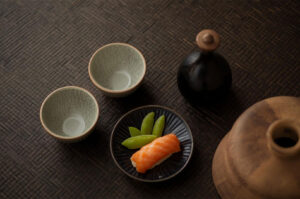
As Japan’s national beverage, this traditional sake is present at celebrations, quiet dinners, and spiritual offerings, weaving itself into the very fabric of daily life and reflecting Japan’s deep-rooted cultural heritage. Yet, for many outside of Japan, it remains a delightful mystery. You might find yourself wondering, how do you drink sake properly to unlock…
-
The Quiet Pursuit of Perfection: Where to Find the Freshest Sashimi in Singapore
Eat Drink Asia Team | December 3, 2025
In Singapore’s fast-paced city, a growing appreciation for authentic Japanese cuisine is emerging, especially for omakase and its key element: sashimi. Diners now seek experiences that satisfy sophisticated tastes, focusing on true quality rather than convenience. The quest for the best sashimi goes beyond thick salmon slices to embrace seasonality, sourcing, and expert preparation. This…

Understanding Sake Alcohol Content: A Complete Guide to ABV and Flavor
Eda Wong | December 2, 2025
When exploring Japanese sake, many wonder about its grades and complex flavors. Sake’s unique profile offers remarkable versatility, enjoyed in various serving styles and paired with diverse dishes. One fundamental aspect is sake alcohol content. Is sake stronger than wine? How does its alcohol by volume (ABV) compare to beer? The answer is nuanced. Understanding…
-
Japanese Sake: The Complete Guide to Japan’s Traditional Rice Wine
Dio Asahi | November 29, 2025
Japanese Sake: The Complete Guide to Japan’s Traditional Rice Wine While sake has been Japan’s national beverage for over a millennium, its popularity across Asia is at an all-time high. Rooted in Japan’s traditional brewing methods and centuries-old origins. It symbolizes Japan’s cultural heritage and craftsmanship. Understanding this complex brewed alcoholic beverage opens doors to…

Best Japanese Foods in Japan: The Must-Try Dishes
Eda Wong | November 27, 2025
Japan’s culinary world extends far beyond well-known sushi and ramen, revealing a rich variety of regional specialties cherished by locals. While many travelers stick to popular Japanese foods in tourist areas, authentic flavors are best discovered in neighborhood markets, family-run eateries, and seasonal menus reflecting centuries of Japanese cooking tradition. Understanding Japanese cuisine requires more…
-
Japanese Food in Japan: The Ultimate Guide to Authentic Culinary Experiences
Eat Drink Asia Team | November 25, 2025
Experiencing Japanese food in Japan is fundamentally different from eating Japanese cuisine anywhere else. While sushi restaurants and ramen shops have spread globally, the authentic flavors, techniques, and cultural context of Japanese food can only be fully appreciated in its homeland. From meticulously selecting ingredients at peak freshness to centuries-old traditions shaping every meal, eating…
-
Food in Japan: A Complete Guide to Japanese Cuisine and Culinary Culture
Eda Wong | November 22, 2025
The gentle steam rising from a bowl of miso soup carries more than just the earthy aroma of fermented soybeans-it carries centuries of Japanese culture and culinary wisdom. When you eat in Japan, you’re not simply consuming a meal; you’re participating in a ritual that connects you to the seasons, the land, and a philosophy…