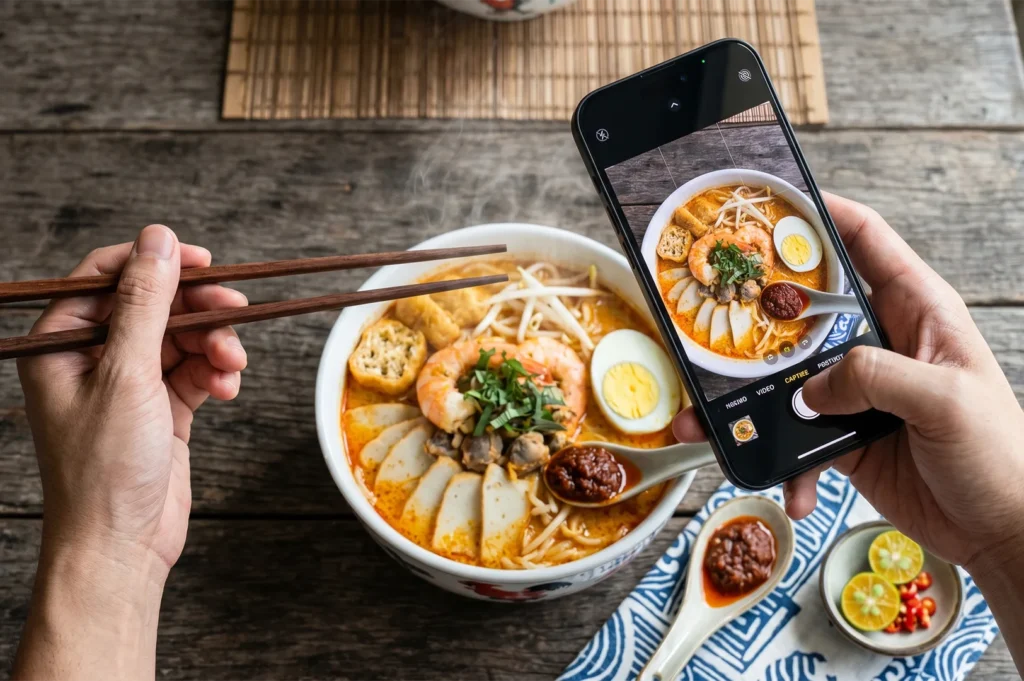
In our first, would probably say, emotional editorial, I would like to open with how there is a particular kind of silence that happens before a dish is eaten now. Not the quiet of anticipation, but the pause of positioning, a hand hovering just above the plate, adjusting the angle of a bowl so the light catches the surface just right. Somewhere between the kitchen and the first bite, food has learned to wait.
I have been a food blogger for a while now, and this topic has a special place in my heart. Because we have watched this shift happen gradually. A bowl of noodles is no longer simply hot and immediate, it is framed. A slice of cake is no longer just soft and sweet, it is cut, rearranged, sometimes rebuilt for the photograph. In this space between aesthetic and appetite, the modern food blogger operates.
At its best, this attention to beauty does something meaningful. SG Food Blogger, and of course us here in Eat Drink Asia, believes that it slows us down and asks us to look closely, to notice the sheen of a sauce or the uneven edges of something handmade. These details carry memory, especially in dishes shaped by long-standing recipes and quiet traditions. In these moments, the visual becomes a form of respect.
But there is a quiet tension underneath. What is being preserved is often not the food itself, but a version of it, styled and adjusted before it is shared. The dish that is eventually eaten is no longer the same one that was captured. It has cooled, settled, and shifted, becoming something slightly removed from its original state.
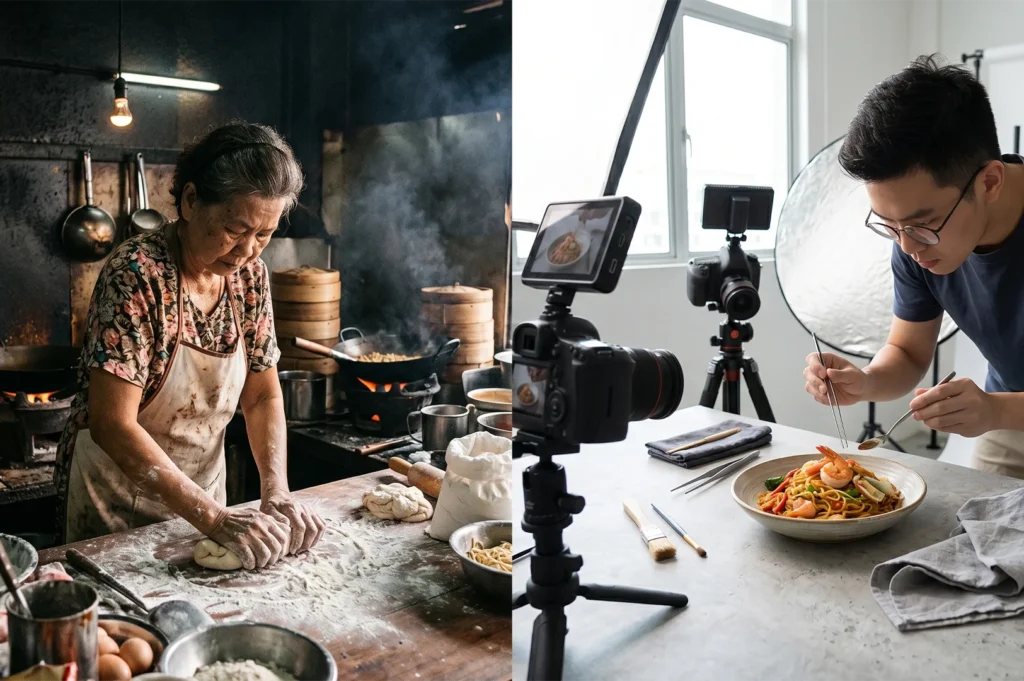
And in that shift, appetite becomes secondary. Food in hawker stalls, family kitchens, and small specialty spaces was never meant to wait. It was built on timing, on being eaten at the exact moment it reaches its peak. To delay that moment is to change the experience.
Yet documentation has also become a form of preservation. Many dishes today are fragile not in texture, but in continuity. Recipes are simplified, techniques forgotten, and entire food traditions begin to fade as the people behind them grow older. In this sense, the camera becomes a tool of memory.
But memory, shaped by aesthetic expectation, begins to change. Colours are adjusted, portions curated, complexity reduced into something more visually clear. A layered dish becomes a clean image, easier to understand but further from how it truly exists.
We see this most clearly in how recipes travel. Traditional preparations are reworked into quicker, simpler versions. Adaptation is not new, it has always been part of how food survives. But there is a point where reduction begins to remove what made the dish whole.
Some food bloggers resist this pressure. They allow dishes to remain slightly uneven, imperfect, and real. Their work feels closer to the act of eating, less controlled but more honest. They remind us that food is not meant to stay still, but to move and be consumed.
Perhaps the balance lies here. Not in rejecting beauty, but in placing it beside appetite rather than ahead of it. A dish is not complete when it is photographed, but when it is eaten. If we are to preserve food meaningfully, we must remember that the recipe is not the image, and the specialty is not the styling. The experience, always, comes after.

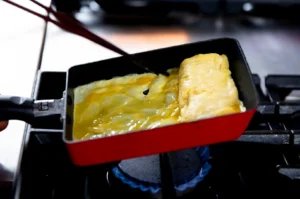
The Last Turn of Tamagoyaki in a Tsukiji Pan
Dio Asahi | October 7, 2026
By Dio Asahi for Eat Drink Asia. It’s mid-morning, and the cook doesn’t look up. He stands over a rectangular pan, copper worn to a dull gold at the edges, and pours a thin skin of beaten egg across its surface. It hisses. Steam rises, warm and faintly sweet, and he tilts the pan just…
-
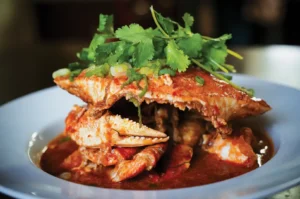
Seafood Restaurants in Singapore That Turn Crab Night Into a Full Table Ritual
Dio Asahi | October 6, 2026
It always starts the same way for me. Someone lifts the lid off a plate of chilli crab, and the whole table leans in. Fingers reach before spoons do. Somebody tears the first piece of fried mantou, drags it through that sticky, sweet-savoury sauce, and the rest of us stop talking for a second. That…
-
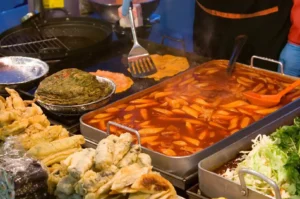
Korean Street Food Is Built for Movement, Heat, and One-Handed Eating
Eda Wong | October 3, 2026
The first time I ate tteokbokki in Seoul, I burned my tongue standing up. It was late, the air was sharp with cold, and I had stopped at a small street food stall near a subway exit because the steam pulled me in. The woman handed me a paper cup of rice cakes in red…
-
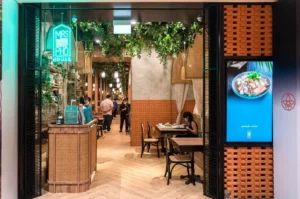
Mrs Pho and the Bowl That Makes Somerset Feel Like a Vietnamese Family Table
Eat Drink Asia Team | October 1, 2026
I wasn’t hungry when I walked into 313@somerset. I’d come for something else entirely; an errand, a shop I needed, the usual Orchard rush of people moving faster than the escalators. But somewhere on the first floor, past the noise, I caught the smell of star anise and beef bone, and my feet slowed down…
-
The Carving Knife at Colony, and the Way We Mark What Matters
Eda Wong | September 30, 2026
By Eda Wong for Eat Drink Asia. It’s late morning, and the light is doing most of the work. It pours through the high windows of Colony, at The Ritz-Carlton, Millenia Singapore, spilling across white tablecloths and the vintage prints on the walls. Marina Bay hums somewhere outside, but in here the room feels a…
-
Co Chung Vietnamese Restaurant and the Gỏi Cuốn That Makes Fresh Herbs Do the Work
Dio Asahi | September 29, 2026
I found it by accident, the way you find most things in a mall basement. I’d come down to Plaza Singapura’s B2 for something else entirely, drifting past the usual food-court noise, when I caught the smell of star anise and beef bone coming from a corner. I followed it. And there it was —…
-
Vietnamese Spring Roll: The Recipe That Only Works When the Herbs Stay Awake
Eda Wong | September 26, 2026
Fresh Vietnamese spring rolls, or gỏi cuốn, look delicate, but the recipe is really about control: barely softened rice paper, dry herbs, restrained noodles, clean protein, and a dipping sauce sharp enough to wake the whole thing up. This is not the fried version, chả giò or nem rán. This is the cool, translucent, herb-heavy…
-
Best Steakhouse Singapore: From Fire-Kissed Icons to Old-School Beef Plates
Eat Drink Asia Team | September 24, 2026
I didn’t set out to write about steak. It started with a bad day and a craving for something that pushed back when I bit into it. One dinner turned into a habit, and over a couple of years I found myself at counters, coffeeshops, and dining rooms all over this island, chasing the same…
-
The Ice Counter at Carousel, and the Table Everyone Can Reach
Dio Asahi | September 23, 2026
By Dio Asahi for Eat Drink Asia. It’s a Saturday evening, and someone across the room is carrying a birthday cake. The candles are lit, the walk is careful, and a whole table turns to watch. Plates clink. A child laughs somewhere. The room at Carousel, inside Royal Plaza on Scotts, isn’t quiet — it…
-
Tiong Shian Porridge Centre Review: The Soft Counterweight to Chinatown’s Crisp Toast
Dio Asahi | September 22, 2026
I’d spent the morning with kaya toast. Crisp bread, cold butter, the clean snap of it between my teeth. Good, all of it. But by the time I’d walked a few streets over to New Bridge Road, my mouth wanted the opposite. Something warm. Something that gave way instead of shattering. That’s how I ended…