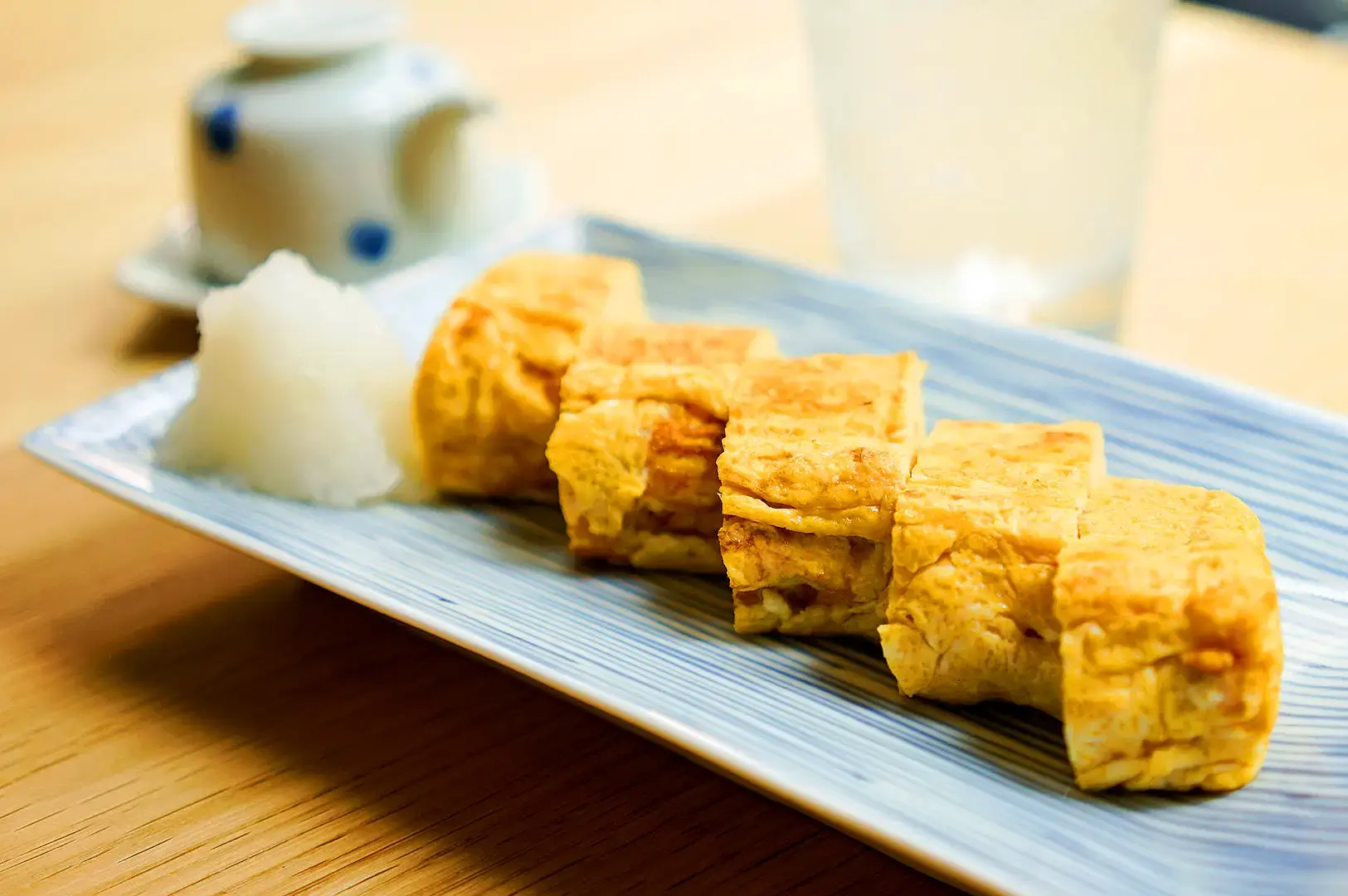
Dashimaki tamago is one of those dishes that looks quieter than it is.
At first glance, it is just a rolled egg. Pale, soft, sliced neatly, often served beside steamed rice, miso soup, and grated daikon radish. But once you make it, you realise it is not really about eggs alone. It is about how broth changes texture, how medium heat asks for patience, and how a thin layer of egg can become something tender enough to feel almost custardy.
If you love Japanese food, this is one of the best small dishes to practise at home because it shows how Japanese cuisine can turn simple ingredients into something delicate, savoury, and deeply comforting.
Dashimaki Recipe at a Glance
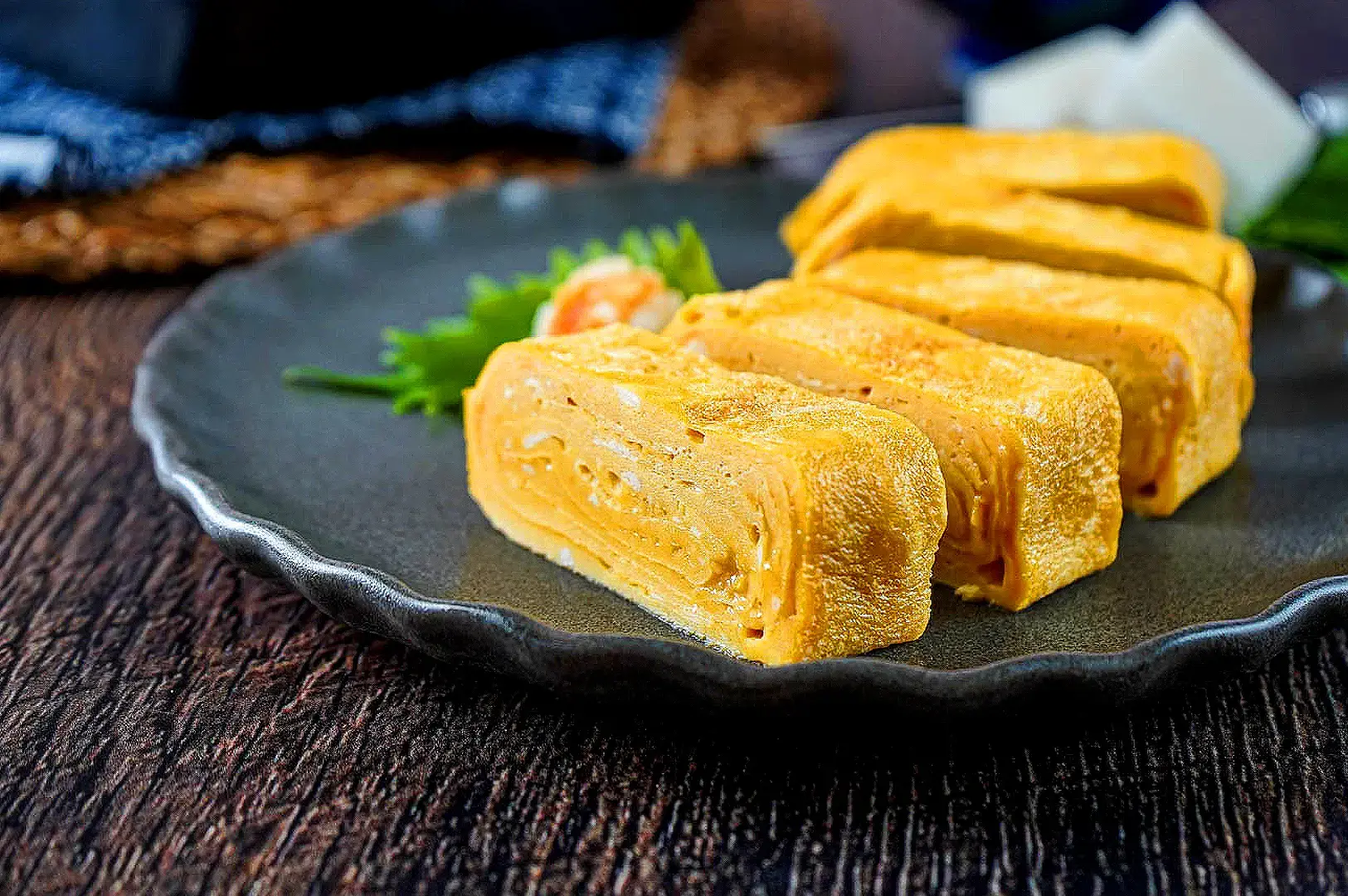
Dashimaki tamago is a Japanese rolled omelette made with eggs and dashi stock. It behaves differently from a western omelette because the egg mixture contains more liquid. That dashi gives the finished rolled omelette its soft, savoury, almost custardy texture.
Time, Yield, and Difficulty
- Prep time: 10 minutes
- Cook time: 10 to 15 minutes
- Total time: 20 to 25 minutes
- Serves: 2
- Difficulty: Medium, mostly because of the rolling
- Best pan: Rectangular tamagoyaki pan, but a small nonstick pan or round pan works
The goal is not a dry, firm omelette. The goal is soft layers that hold together just enough while still tasting like Japanese soup stock.
What Is Dashimaki Tamago Japanese Rolled Omelette?
Dashimaki tamago, sometimes written as dashi maki tamago, is a Japanese rolled omelette. Beaten eggs are mixed with dashi stock, light soy sauce, mirin, granulated sugar, and salt, then cooked one thin layer at a time. Each egg layer is rolled into the last until all the egg mixture becomes one soft log.
It is often confused with tamagoyaki, but they are not exactly the same. Tamagoyaki usually has little or no dashi, so it is firmer and easier to roll. Dashimaki tamago carries more dashi mixture, which makes it softer, juicier, and more delicate. Atsuyaki tamago tends to be thicker, sweeter, and firmer, which is why it holds up better in bento boxes and sushi restaurants.
For the restaurant side of that same quiet precision, Eat Drink Asia’s piece on best omakase Singapore shows how small Japanese courses turn restraint into storytelling.
Ingredients for Dashimaki Tamago
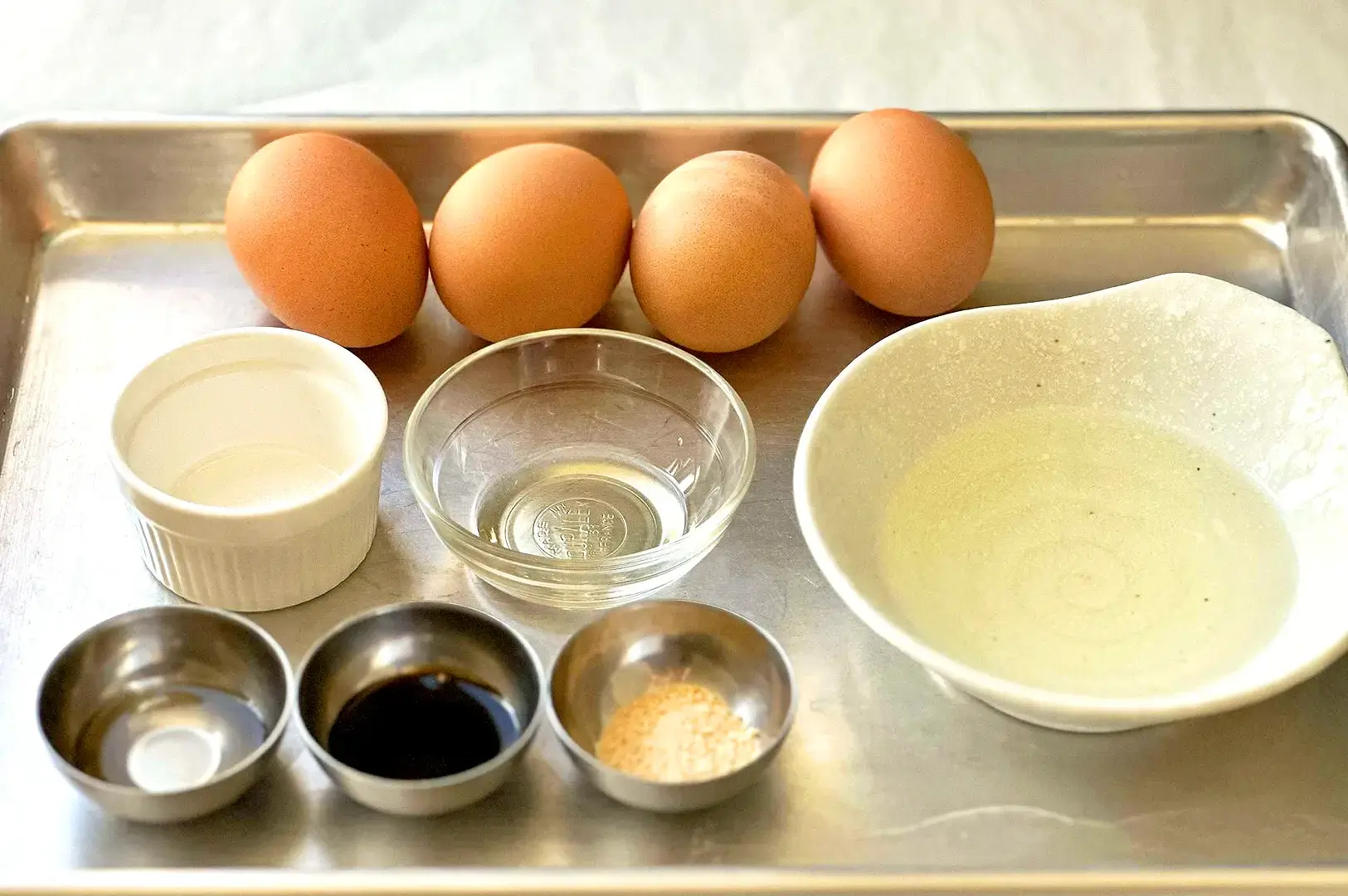
This is the basic recipe I would hand to someone trying to make dashimaki tamago for the first time. It has enough dashi to taste clearly, but not so much that the roll fights you at every turn.
For the Egg Mixture
- 3 large eggs
- 45 to 60 ml dashi stock
- 1 tsp light soy sauce, usukuchi soy sauce if you have it
- 1 tsp mirin
- 1 to 2 tsp granulated sugar, to taste
- Pinch of salt
- Vegetable oil, for the pan
To Serve
- Grated daikon radish
- A small splash of soy sauce
- Steamed rice, miso soup, or pickles
For dashi, homemade awase dashi made with kombu and bonito flakes gives the cleanest flavour. Instant dashi powder is honest weekday cooking. Use about 1 tsp instant dashi powder to 240 ml hot water, then measure only what you need. Do not add too much soy sauce. If you only have regular Japanese soy sauce instead of white soy sauce or usukuchi, use it lightly so the omelette stays pale.
Equipment You Need
A tamagoyaki pan makes the roll neater, but it is not required. A rectangular tamagoyaki pan or square pan gives the most even shape. A copper tamagoyaki pan conducts heat beautifully, but it is expensive and less forgiving. For most home cooks, a nonstick rectangle pan is easier.
Best Beginner Setup
- Rectangular tamagoyaki pan, square pan, or small round frying pan
- Chopsticks or a thin spatula
- Folded paper towel
- Separate bowl for seasoning
- Measuring cup with a spout
- Bamboo mat or bamboo sushi mat
- Optional wooden lid if you already use one for rolling
The folded paper towel matters more than it looks. Dip it in vegetable oil and keep the oil soaked paper towel beside the stove. You will use the oiled paper towel to lightly grease the pan between layers. A thin film of oil keeps the roll moving without making it greasy.
How to Make Dashimaki Tamago
1. Mix the Dashi Seasoning
In a separate bowl, combine the dashi stock, soy sauce, mirin, sugar, and salt. Stir until the sugar dissolves. Taste before adding it to the eggs. It should be savoury, lightly sweet, and balanced, not aggressively salty.
2. Beat the Eggs Gently
Crack the eggs into a bowl and cut through the yolks and egg whites with chopsticks. Do not whip. Too much air creates air bubbles and uneven layers. This is not a soufflé. Add the dashi mixture and stir gently. For a smoother dashimaki tamago recipe, strain the beaten eggs into a measuring cup. It catches stubborn strands of egg whites and makes repeated pouring easier.
3. Heat and Oil the Frying Pan
Set the frying pan over medium heat. Dip the folded paper towel in vegetable oil and wipe the pan with a thin, even layer. The pan is ready when a drop of egg makes a gentle sizzling sound. No sound means the pan is too cold. Angry crackling means the cooking temperature is too high.
4. Pour the First Thin Layer
Pour in just enough egg mixture to cover the base. Tilt the pan so the egg runs into every corner and fills the empty space. If bubbles rise, pop them with chopsticks.
5. Start Rolling While the Egg Is Still Soft
Start rolling from the far side toward you. Use chopsticks, a spatula, or a wooden lid if that is how you learned from tamagoyaki recipes. The first roll may look a little wrinkled, but that is fine. It will become the centre of the rolled egg and disappear inside later layers.
6. Re-Oil, Pour, and Repeat
Slide the roll back to the far end of the pan. Wipe the exposed pan with the oiled paper towel, then lift the roll slightly and pour another thin layer of egg underneath it. This fresh egg acts like glue between the old cooked egg and the new layer.
Repeat until you use all the egg mixture: roll, move, oil, pour. Roll, move, oil, pour. Rhythm matters more than speed.
7. Shape It While Hot
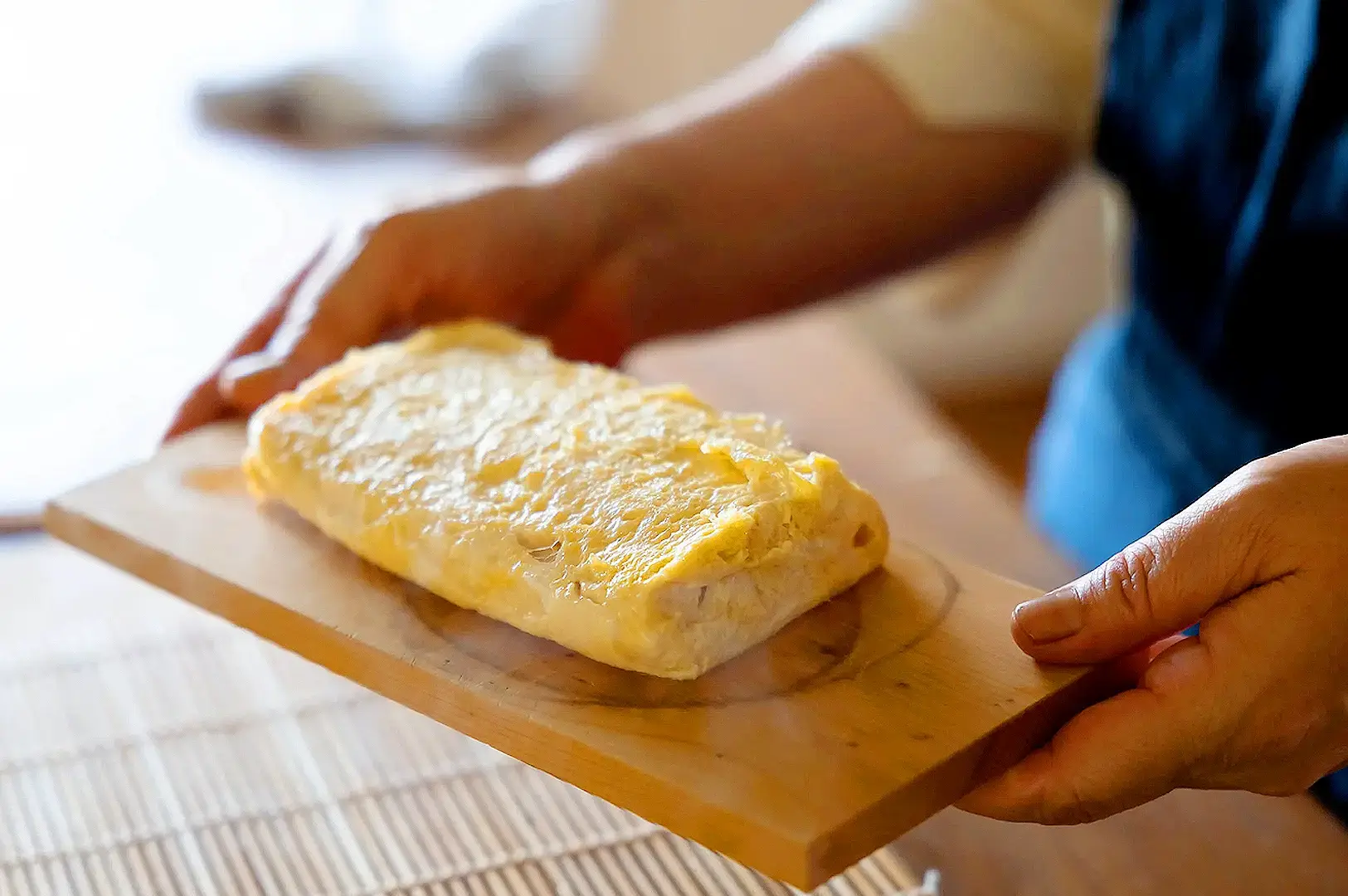
When the omelette is done, transfer it to a sushi mat or bamboo mat. Wrap and press gently for about five minutes. This helps turn a wobbly home roll into a cleaner log. Do not squeeze too hard. Too much pressure pushes out the dashi.
8. Slice and Serve
Slice the dashimaki into thick pieces while warm. Serve with grated daikon, grated daikon radish, and just a dash of soy sauce. Dashimaki is best eaten right away. The same dashi that makes it tender can weep out if it sits too long.
How Much Dashi Stock Should You Use?
For beginners, start with 45 ml dashi for 3 eggs. This gives you enough broth flavour without making the Japanese rolled omelette too fragile.
Dashi Levels by Skill
- Beginner: 3 eggs plus 45 ml dashi
- Confident home cook: 3 eggs plus 60 ml dashi
- Soft restaurant-style attempt: 3 eggs plus 80 to 100 ml dashi
Every extra splash of dashi makes the omelette more delicious and less obedient. That is the trade. A delicious dashimaki tamago recipe is not about forcing restaurant softness on the first try. It is about building enough control to handle more broth later.
What to Serve with Dashimaki Tamago and Miso Soup
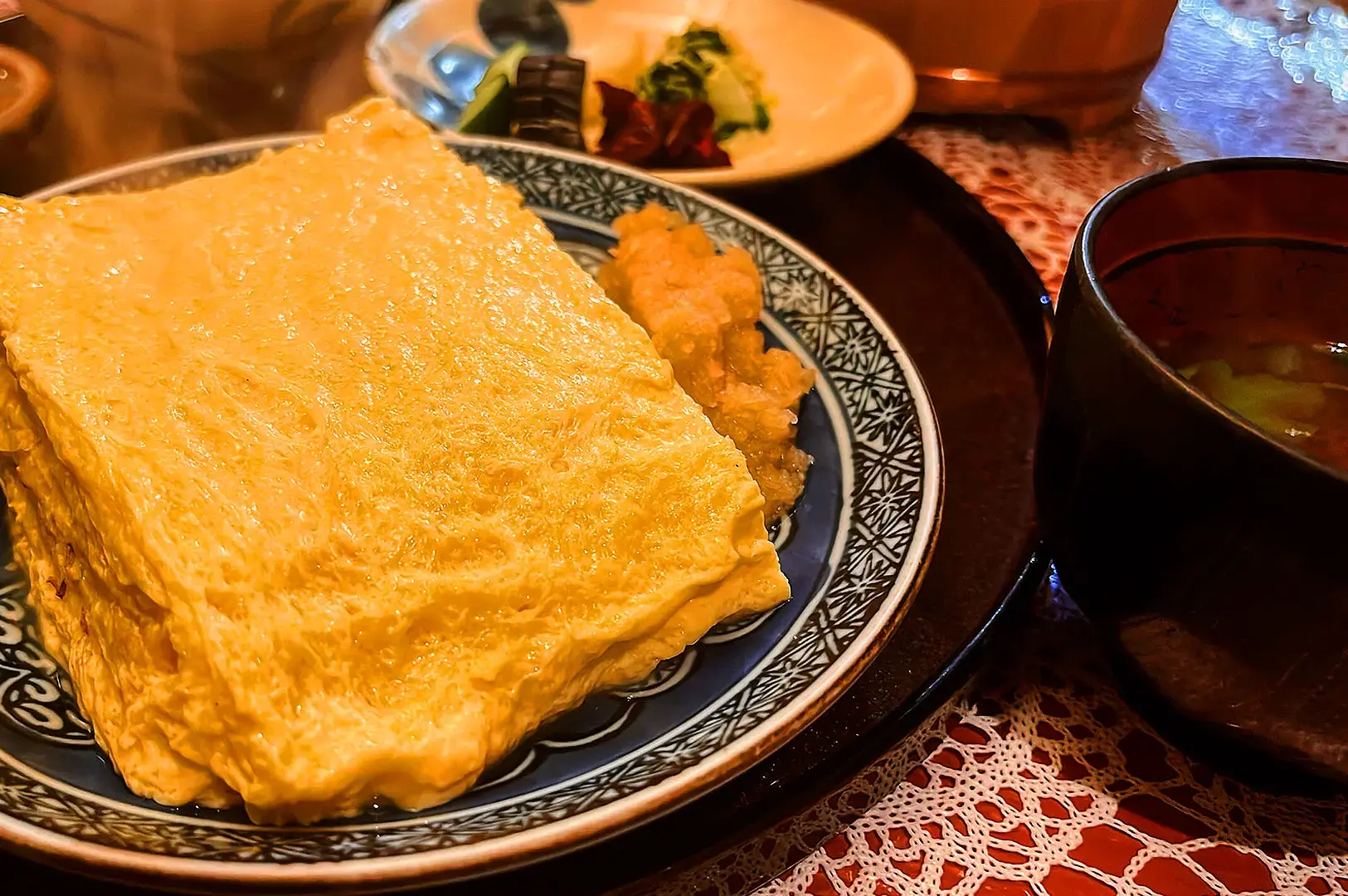
At home, dashimaki works beautifully as part of a Japanese breakfast. I like it beside steamed rice, miso soup, pickles, and maybe grilled fish. The aroma is quiet but comforting: warm egg, bonito, soy, and the clean steam of rice.
This is where the dish starts to make sense as Japanese food. The same dashi that seasons the rolled egg can also sit beneath miso soup and other Japanese dishes. Learning dashimaki is really learning how Japanese cuisine uses stock to season food that does not look like soup.
If dashimaki feels like the quiet side of Japanese comfort, izakaya Singapore guide shows how small plates carry that same relaxed rhythm into dinner.
Cost, Shopping Notes, and Recipe Ratings
Dashimaki is a cheap dish to love. Eggs, dashi, soy sauce, mirin, sugar, and oil are modest ingredients, and each batch uses only small amounts. You do not need a copper pan, white soy sauce, or restaurant tools for your first try.
If you are buying equipment, start with a basic nonstick tamagoyaki pan. A copper tamagoyaki pan can come later, once you know you enjoy the rhythm. If you are reading recipe ratings before cooking, check whether the recipe creator uses a beginner dashi ratio or a restaurant-style one. Some dark instructions from glossy videos make the process look effortless, but a high-dashi roll takes practice.
Before You Cook
Before you make dashimaki tamago, remember what the dish is asking from you. Not speed. Not force. Not a perfect restaurant shape on the first attempt. It asks for medium heat, thin layers, and attention. It asks you to trust the half cooked surface, to keep the oiled paper towel nearby, and to use all the egg mixture slowly rather than flooding the pan.
Start with 45 ml dashi. Keep the layers thin. Let the rhythm teach your hands. The good roll is closer than you think.

The Malayan Council, Reviewed: Local Food in Malaysia, Plated Like a Memory
Eat Drink Asia Team | June 11, 2026
Our Eat Drink Asia team spends a lot of time debating what makes a truly unforgettable meal. The team has previously published articles exploring the redefinition of comfort food. That is exactly what led me to The Malayan Council at 71 Bussorah Street. I visited on a Friday around 7:30 pm, just as the weekend…

Sushi in Singapore: Why There Is a Style for Every Budget
Eda Wong | June 11, 2026
Few Japanese dishes have travelled as successfully across Asia as sushi. What began as a culinary tradition deeply rooted in Japan has evolved into something remarkably diverse in Singapore. Today, sushi in Singapore can mean many different things. It can be a quick lunch grabbed from a conveyor belt restaurant, a carefully curated omakase meal…
-
The Quiet Pull of Lahpet in Myanmar’s Tea Leaf Salad
Dio Asahi | June 10, 2026
The afternoon humidity presses against the open-air teahouse in downtown Yangon, where the sharp clatter of a silver spoon against ceramic cuts through the low hum of conversation. A small plate sits in the centre of a low plastic table, holding a dense, dark green cluster that smells faintly of damp earth and sharp lime….
-
Dining at Suntec: The Restaurants That Feel Like Different Cities in One Mall
Eda Wong | June 9, 2026
Over the past six months, I’ve navigated the sprawling, sometimes disorientating corridors of Suntec City more times than I can count. What started as a simple quest to find decent spots for post-meeting lunches quickly turned into a genuine culinary journey. I have tried over a dozen venues within this massive complex, and I’ve found…
-
PappaRich SG and the Comfort of Malaysian Staple Food: A Restaurant Review in Familiar Flavours
Dio Asahi | June 6, 2026
There is a very specific kind of exhaustion that hits you right before a flight or just after you land. You are dragging your suitcase, staring blankly at the departure boards, and suddenly, you realize you are starving. But you don’t want just any food. You want something warm, familiar, and deeply comforting. I felt…
-
Sri Lanka’s Ambul Thiyal and the Sourness of Goraka
Eda Wong | June 5, 2026
In the open-air kitchen of a coastal home in southern Sri Lanka, a low fire crackles under a wide, unglazed clay pot. The air is thick with the scent of roasted black pepper and something deeply, aggressively tart. A wooden spoon scrapes the bottom of the pot, turning cubes of firm yellowfin tuna until they…
-
Traditional Malaysian Foods Aren’t a Museum: They’re a Living Argument at the Table
Eda Wong | June 4, 2026
When I first really started digging into traditional Malaysian food, I made a classic rookie mistake. I was sitting at a crowded kopitiam in Kuala Lumpur, looking at a plate of nasi lemak, and I thought I understood exactly what it was supposed to be. I thought it was a fixed, rigid recipe, a museum…
-
In Gifu, Hoba Miso Warms Slowly Over Magnolia Leaves
Dio Asahi | June 3, 2026
Frost clings to the wooden window frames in the highlands of Gifu. Inside, the air is thick with the scent of woodsmoke and fermented soybeans. On the table, a small ceramic charcoal grill known as a shichirin radiates a gentle, localized heat. Resting directly above the glowing embers is a large, brittle brown leaf holding…
-
The Stir Fried Egg Plant That Taught Me Restraint at Si Chuan Dou Hua Restaurant
Eat Drink Asia Team | June 2, 2026
I’ve always had a love-hate relationship with Sichuan food. Usually, you walk into a spot, order your food, and spend the rest of the night sweating through your shirt, chugging ice water, and wondering why you did this to yourself. But when I visited Si Chuan Dou Hua Restaurant on a Tuesday around 7 pm,…
-
What the Wok Is Really Doing to the Vegetable: The Question Behind Every ‘Brinjal Recipe Chinese Style’
Dio Asahi | May 30, 2026
When I first tried cooking brinjal at home, I was completely convinced that all I needed was a hot pan, some oil, and a good recipe. I chopped the vibrant purple vegetable, threw it into a standard frying pan with a generous pour of oil, and waited for the magic to happen. Instead of the…